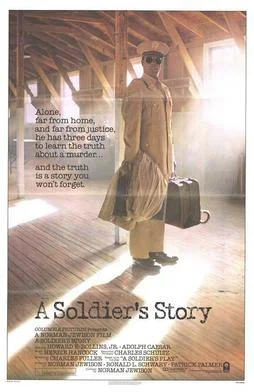
Directed by Norman Jewison in 1984, A Soldier's Story occupies a unique position within both the director's oeuvre and the wider context of American cinema. Known for addressing complex social issues, Jewison crafts a narrative that delves deep into the racial dynamics of the U.S. military during World War II. While Jewison’s previous works have celebrated the fight for justice and equality, A Soldier's Story presents a more challenging dialogue that explores themes of racial tension, military hierarchy, and internalized self-hate, ultimately encapsulating the struggle for identity and recognition within an oppressive system.
Critics have often highlighted the film's exploration of racial disparity as its most significant aspect. The storyline follows an investigation into the murder of a Black soldier, peeling back layers of prejudice and cruelty that permeate military life. This context serves to foreground a critical examination of justice, or the lack thereof, within institutional frameworks. The film effectively showcases the tension that arises from entrenched hierarchies, compelling both audience and characters to wrestle with the painful realities of systemic racism. However, some viewers have noted that while the film aims to dissect these weighty themes, it occasionally falters, landing in the realm of the mechanical and pale.
The performances throughout A Soldier's Story carry the weight of the narrative, yet at times they are described as disappointing and limited. Though the actors strive to bring depth to their roles, the mechanical pacing of the script sometimes undermines their efforts. One might say the film presents a poignant story, yet it often feels trapped in a formulaic structure that diminishes its emotional impact. Critics have described certain moments as excruciating, as the film grapples with heavy themes yet lacks the resonance needed to fully engage the audience on a deeper emotional level.
In its quest for justice and truth, A Soldier's Story raises pertinent questions regarding self-hate among the characters, highlighting the internal conflicts that arise when identity clashes with imposed societal roles. The film endeavors to initiate a cathartic dialogue on race and identity, but it ultimately struggles to elicit the necessary emotional engagement from its viewers. This internal struggle and the portrayal of complex characters add layers to the film's narrative; however, even with these undertones, the critical consensus leans toward viewing the film as an exercise that, while ambitious, does not entirely succeed in fulfilling its potential.
Overall, A Soldier's Story stands as an important artifact within the annals of cinema, representing both the challenges and the potentials of addressing race and justice in film. Its ambition to confront the deep-seated issues of racism and hierarchy is clear; nonetheless, the execution often feels flat, leaving audiences in reflection more than resolution. As part of Jewison's body of work, it is a reminder of the complexities of storytelling, where themes of justice are often ensnared in the very structures they seek to dismantle.