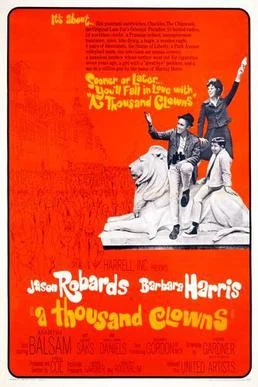
A Thousand Clowns, directed by Fred Coe in 1965, stands as a unique entry in the pantheon of American cinema during a time marked by both cultural upheaval and a quest for new narrative forms. Coe, known for his work in television and for his ability to mine the complexities of human relationships, delivers a film that juxtaposes the lighthearted with the earnest. While the film may not fully capture the zeitgeist of the '60s counterculture movement, it embodies a whimsical exploration of nonconformity, particularly through its central character, Murray, played by Jason Robards. This film ventures into themes of fatherhood and the struggle for personal identity, which were becoming increasingly relevant considerations for American audiences searching for meaning amidst the chaos of their times.
Critically, A Thousand Clowns has been characterized as both humorous and heartfelt, a sentiment echoed by many reviewers who appreciated its quirky take on parenting and social responsibility. The film portrays the day-to-day life of Murray, a caring guardian who believes in defying societal norms to nurture his young ward, Nick. The interplay between their characters encapsulates a nostalgic longing for an alternative family structure, one that prioritizes creativity and love over conventional success. Yet, beneath its humorous surface, the film grapples with deeper questions about child welfare and the sometimes misguided attempts of nonconformists to foster an environment conducive to personal growth.
However, the film does not escape criticism. Some reviews have described it as overcalculated and underwhelming, suggesting that the film's attempts to balance sentimentality and humor may ultimately miss their mark. Though engaging in parts, the narrative unfolds in a manner that some found disappointing, leading to perceptions of missed potential. While the zany antics of Murray might entertain in moments, they do not always resonate as deeply or meaningfully as intended. The film, although well-executed in its craft, can often feel dated, its charm clouded by contemporary expectations of character development and narrative pacing.
The film’s nostalgic flavor is both its strength and weakness, resonating deeply with audiences yearning for a simpler time while simultaneously revealing itself as perhaps misguided in its romanticized view of nonconformity. While some may find inspiration in Murray's free-spirited lifestyle and his genuine affection for Nick, others may see this as an idealized portrayal that glosses over the serious responsibilities of fatherhood. This tension within the narrative serves as a microcosm of broader societal conflicts in the 1960s, between tradition and change, practicality and artistic freedom.
In conclusion, A Thousand Clowns invites viewers to contemplate the nuances of love, parenting, and the delicate balance of identity within societal constraints. Though its critical consensus remains mixed, the film is, at its core, an engaging exploration of what it means to be a parent in an ever-evolving world. Whether one views it as whimsical or misguided, its themes of fatherhood and personal growth continue to resonate, ensuring that Coe's film occupies a distinct place in the annals of American storytelling.