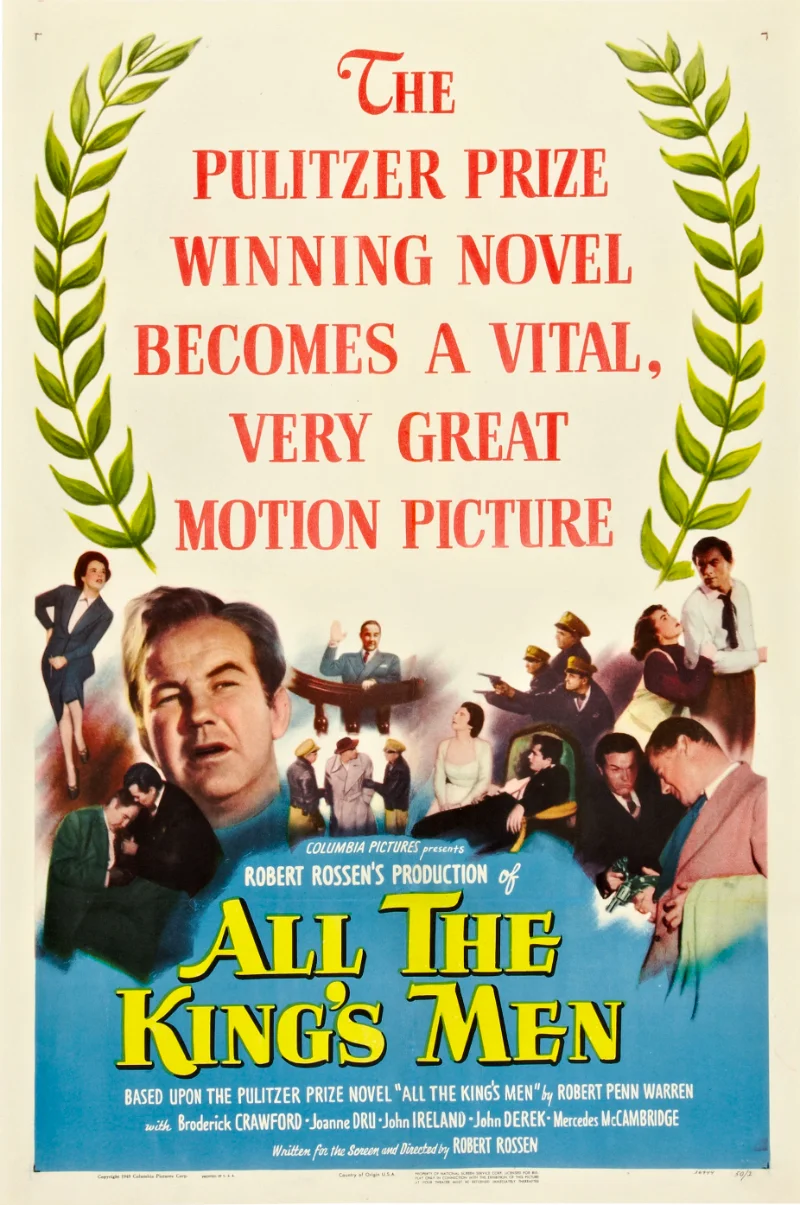
In the landscape of American cinema, All the King's Men (1949) stands as a monumental exploration of political machinations and the complexities of moral compromise. Directed by Robert Rossen, the film draws inspiration from the life of Louisiana politician Huey Long, effectively weaving themes of idealism and corruption into a narrative that feels deeply resonant even decades after its release. Rossen, known for his ability to capture the gritty realities of human nature and power, encapsulates a post-war America grappling with disillusionment, a trend that echoes in the broader context of film noir and socially conscious dramas of the late 1940s.
Critics of the time and contemporary reviewers alike have noted the film’s deep dive into the murky waters of political ambition. The rise and fall of Willie Stark, portrayed with gravitas by Broderick Crawford, is a potent allegory of the seductive nature of power and the moral ambiguities that accompany it. Stark starts as a charming idealist, aiming for the greater good of the people, but as he ascends to power, he becomes entangled in the very corruption he sought to eradicate. This evolution serves as a cautionary tale, illustrating how the ideals that propel individuals into the public sphere can easily succumb to the corrupting influences of power.
The critical consensus around All the King's Men encapsulates a mixture of admiration and frustration. Some reviews commend it as a towering achievement, marked by assured performances and a complex narrative that avoids simplistic portrayals of heroism or villainy. Yet, it is also acknowledged that the film can be cumbersome at times, with moments of overacting that detract from the emotional core. Despite its narrative muddles, the film’s dramatic punch resonates; it forces audiences to confront uncomfortable truths about the American political landscape and the moral compromises that often accompany governance.
Visually and thematically, Rossen's work here is colored by a gloomy aesthetic, evoking a sense of listlessness in the political arena. Critics have pointed out how the film's dramatic and savage undertones invite viewers to reflect on power dynamics that remain relevant today. The eerie atmosphere complements the complex humanity of its characters, offering a deep exploration of the interplay between idealism and the harsh realities that shape political life.
The film's historical accuracy may be debated, as it takes creative liberties in portraying events and characters. Nevertheless, All the King's Men transcends mere biographical recounting; it paints a broader picture of the pressures that cloud moral judgment in the quest for power. Audiences are left with a haunting awareness of how ambition can lead to moral decay, and this ambivalence has cemented the film's place in the canon of American cinema. In a world where political corruption and idealism remain as relevant as ever, Rossen's work feels hauntingly prescient, urging a critical examination of the leaders we choose.