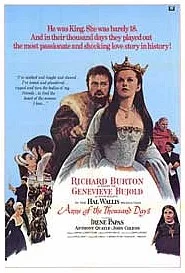
Directed by Charles Jarrott, Anne of the Thousand Days is a notable entry in the realm of historical drama that not only explores the intricacies of Tudor court politics but also encapsulates the gender dynamics of the time. Released in 1969, this film serves as both a vital part of Jarrott's filmography and a cornerstone of the period piece genre, standing out for its costume-heavy storytelling and biographical focus on one of history’s most intriguing women, Anne Boleyn. The film invites viewers to traverse the labyrinth of ambition and betrayal that characterized the English court during a tumultuous time, marked fundamentally by the Reformation and questions of succession.
The central narrative of Anne of the Thousand Days revolves around the passionate yet perilous courtship between Anne Boleyn and King Henry VIII. Through its depiction of their relationship, the film succeeds in delineating the power dynamics inherent in Tudor politics, highlighting how personal ambitions can intertwine with historical events. As Anne oscillates between a position of influence and one of jeopardy, her struggle against rigid gender roles becomes a poignant theme. Critics have noted how Jarrott effectively utilizes a dramatic and conventional storytelling approach to unfold the tragic arc of a woman who dared to change the course of history, with her downfall ultimately symbolizing the dangerous intersections of love and power.
The film's historical accuracy has garnered mixed reviews; while it embraces dramatic licenses typical of adaptations, it remains committed to portraying significant events with an air of authenticity. Critics point to the elaborate costumes and settings that adorn the film, enhancing its biographical essence while immersing the audience in a world that is both visually opulent and marked by tension. This careful attention to detail serves not just as a feast for the eyes but also as a reminder of the heavy burdens the characters bear. The lush visuals stand in stark contrast to Anne's tragic fate, eliciting a deeper emotional response from the audience.
Another significant thread in the narrative of Anne of the Thousand Days is the exploration of betrayal, which underpins the relationships throughout the Tudor court. The film encapsulates how trust can be a fleeting commodity in environments governed by ambition and the relentless pursuit of power. As alliances shift and loyalties are tested, viewers witness the precariousness of courtly life, where every friendship and romance is tainted by ulterior motives. Through Anne's interaction with figures such as Cardinal Wolsey and Thomas More, the film provides a reflection on how political machinations can overshadow personal desires, thereby reinforcing the tragic outcomes that often accompany a lust for power.
In summation, Anne of the Thousand Days stands as a compelling historical drama that intricately weaves together themes of ambition, betrayal, and the complexities of love within the patriarchal confines of the Tudor court. Jarrott's direction, while conventional, is skillful in drawing out the emotional depth of its characters, making the film resonate with both historical enthusiasts and general audiences alike. Its legacy endures as a significant portrayal of a woman who sought not only love but the throne, navigating the perilous waters of a world where every choice could be a fatal one.