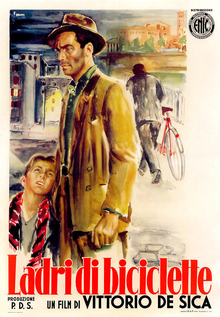
Bicycle Thieves, directed by Vittorio De Sica in 1948, stands as a pillar of Italian Neorealism and a fundamental work in the canon of world cinema. Set against the post-World War II backdrop in Italy, the film presents an unflinching look at poverty and the struggle for survival in a devastated urban landscape. De Sica's direction masterfully captures the rawness of everyday life, emphasizing the systemic inequalities faced by ordinary people. This film is pivotal not only in De Sica's oeuvre but also in the Neorealist movement, which sought to portray the authentic experiences of the marginalized using non-professional actors and real locations.
At the heart of Bicycle Thieves is the poignant relationship between a father and son, portrayed by Lamberto Maggiorani and Enzo Staiola. Antonio, the father, embarks on a desperate quest to recover his stolen bicycle, which is his only means to secure employment. This narrative thread cleverly encapsulates broader themes of human dignity within the oppressive folds of poverty. The film's emotional weight is derived from Antonio's struggle not only against external circumstances but also from his desire to provide a better future for his son, Bruno. Their dynamic, laden with love and desperation, reflects a universal bond, emphasizing how such relationships are tested amidst dire social conditions.
Critics have heralded Bicycle Thieves as a heart-wrenching and affecting exploration of human despair. The film's authenticity resonates as a direct portrayal of the human condition, exposing the unbearable realities faced by many in post-war society. Through its simple yet profound narrative, De Sica presents a powerful humanist perspective that critiques societal indifference to individual suffering. The film serves as a parable, illustrating how systemic poverty can erode dignity and integrity, creating a cycle that transcends time and place.
Moreover, the urban setting of Rome becomes a character in itself, emphasizing the isolation and struggles of its inhabitants. The streets, filled with the echoes of despair and hope, contribute to an atmosphere that is at once immediate and timeless. De Sica's commitment to realism, eschewing melodrama for straightforward storytelling, allows for an immersive viewing experience where audiences are left to confront the stark realities of poverty. The film’s enduring impact speaks to its ability to evoke empathy and reflection on societal issues that remain relevant today, solidifying its status as a classic.
In conclusion, Bicycle Thieves is not merely a film about theft but a profound commentary on the intricacies of human relationships strained under economic pressures. It is a testament to the resilience of the human spirit, representing the painful struggle for dignity that lies at the core of De Sica's vision. The film's timeless resonance, marked by its realistic portrayals and emotional depth, continues to influence filmmakers and capture the hearts of audiences around the globe.