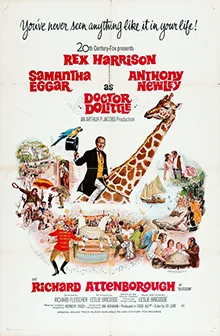
Directed by Richard Fleischer, Doctor Dolittle (1967) stands as a polarizing entry in the pantheon of cinematic adaptations. Based on Hugh Lofting's beloved children's books, the film aimed to capture the whimsical adventures of a doctor who can speak with animals. Although the premise offered rich narrative potential, the endeavor faced significant adaptation challenges that ultimately hindered its success. Fleischer, known for his work in diverse genres, attempted to craft a lavish musical extravaganza; however, the film's ambition quickly outpaced its execution, leading to widespread criticism.
The critical consensus surrounding Doctor Dolittle can best be summarized as one of disappointment. Reviews highlight the movie's lavish production, which came at a hefty cost, often labeling it as overproduced and wasteful. Despite the original charm of Lofting's stories, many found the adaptation to be tedious and uninspired. The humor, intended to resonate with audiences of all ages, was frequently deemed witless, leaving viewers yearning for the sharp wit that characterized other musical endeavors of the era. Such critiques were further compounded by production issues that plagued the film from its inception, all culminating in a product that failed to satisfy the expectations set by its ambitious premise.
Audience reception was predictably lackluster, as the film struggled to connect with viewers in a meaningful way. Failure at the box office was not merely a reflection of its artistic shortcomings but also underscored the disconnect between the film's lavish presentation and the simplicity of its source material. Observers noted a sense of viewer disappointment, as families who flocked to theaters looking for endearing entertainment were instead met with a costly spectacle that felt drawn out and overly complicated. As a result, Doctor Dolittle emerged as a flop, prompting discussions around the pitfalls of adaptation in film.
In the broader context of cinema history, Doctor Dolittle serves as a cautionary tale about the challenges of bringing beloved literary characters to the screen. Its costly missteps highlight the intricate balance needed between artistic vision and audience expectations, particularly in adaptations that risk losing the essence of their source material. Richard Fleischer's work, often lauded for its daring storytelling, therefore finds itself juxtaposed against the overwhelming disappointment of this particular project, marking a notable misfire in his otherwise varied oeuvre. The film remains a striking example of how ambition, when ungrounded in inspiration and coherence, can lead to a legacy defined more by its shortcomings than its achievements.