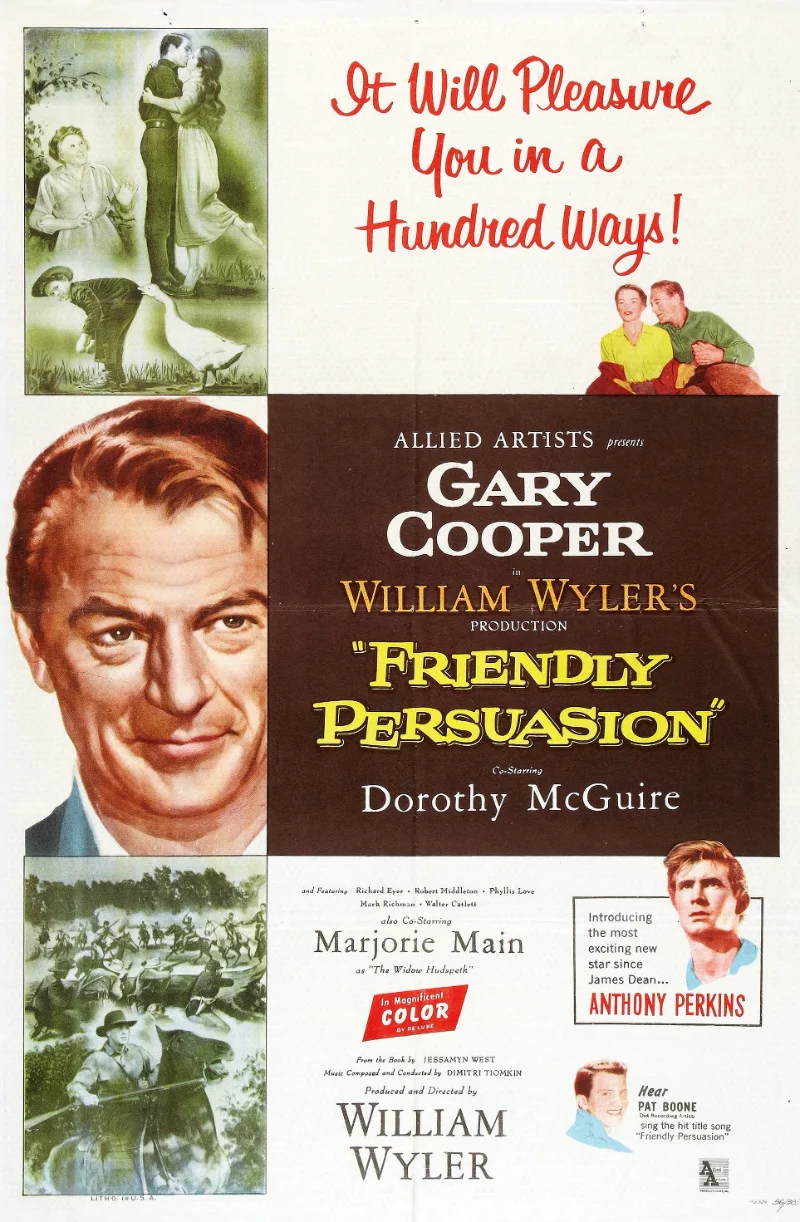
Friendly Persuasion, directed by William Wyler in 1956, stands as a unique intersection of personal conviction and historical context within American cinema. Wyler, known for his deep character portrayals and intricate narratives, employs a delicate touch in this adaptation of Jessamyn West's novel. The film explores the life of a Quaker family during the tumultuous years of the Civil War, highlighting not only the uniqueness of Quakerism but also the broader moral complexities associated with war and peace. While it marks a notable moment in Wyler's oeuvre, it also illustrates a pivotal time in film history where stories of personal and societal conflict began to capture broader audiences, transcending mere spectacle to probe the human condition.
Critics have lauded Friendly Persuasion for its exquisite blend of charm and depth, underlining the film's profound exploration of religious convictions amidst societal upheaval. The focus on a Quaker family offers a fresh perspective on a conflict that is often viewed through a singular lens. The film artfully juxtaposes the serene values of Quaker life with the inevitability of violence and strife represented by the Civil War. Through the struggles of the family, particularly the dynamics of parental authority and the youthful spirit embodied by the children, the film invites viewers to wrestle with the dilemmas of faith versus duty, love versus conflict. This moral ambiguity is not merely a backdrop; it serves as the heartbeat of the narrative, encouraging introspection on the costs of war not just on the battlefield, but within the soul.
At the core of the film is a charm that has earned it a lasting place in American cinema. Critics have described it as an exquisite adaptation that balances humor and poignancy, creating a world that feels simultaneously intimate and expansive. The performances, particularly those of Gary Cooper as the principled patriarch and the enchanting Dorothy McGuire, convey a palpable sense of belonging, drawing viewers into their unique struggles. The film's cinematography further enhances this sense of place, with the pastoral landscapes serving as a serene counterpoint to the chaos of war. Such attention to visual detail not only enriches the storytelling but also harks back to Wyler’s earlier works that frequently dealt with rural settings and complex character interactions.
In examining the critical reception and thematic richness of Friendly Persuasion, it is clear that this film transcends its historical setting. It speaks to universal themes of faith, conflict, and the timeless struggle for peace in the face of adversity. The Quaker principles of non-violence and compassion are tested, leading to moments of introspection that resonate even today in contemporary discussions of morality and ethics. Simply put, Friendly Persuasion remains not merely a film about a specific time and place, but a meditation on the choices that define us as human beings. As such, it represents a significant achievement in Wyler's career, marrying critical acclaim with heartfelt storytelling, and solidifying its status as a classic in the annals of film history.