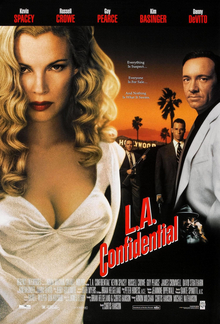
In the annals of American cinema, L.A. Confidential stands as a compelling exemplar of neo-noir filmmaking, situating itself firmly within Curtis Hanson's esteemed body of work. Released in 1997, the film is not merely an adaptation of James Ellroy's novel but a reimagining of Los Angeles lore, weaving together themes of moral ambiguity, heroism, and the dark underbelly of crime fiction. Hanson's expert direction harnesses the seductive and cynical essence of Ellroy’s writing, presenting a landscape that is both familiar and uniquely twisted, reflecting the contradictory nature of Los Angeles itself. The film’s aesthetic resonance with the classic noir genre, alongside its contemporary sensibilities, makes it a notable entry in the late 20th-century cinematic narrative.
Critics have unanimously embraced L.A. Confidential, praising its intricate storytelling and complex characters, which resonate through a landscape of crime, corruption, and moral codes. This gripping experience invites the audience into a world where traditional definitions of heroism are deconstructed. The film wrestles with ambivalence, layering its narrative with characters who defy simplistic categorizations of good and evil. As audiences traverse the mean streets of 1950s Los Angeles, they encounter a multitude of perspectives, each revealing the moral dilemmas facing its protagonists, the stoic and often flawed police officers, the femme fatales, and the elusive criminals. These conflicts evoke a visceral connection to the city, illustrating how its myths and realities morph into a unique tapestry, reflective of broader American societal issues.
The film not only serves as a canvas for star-making roles from an ensemble cast, including Russell Crowe, Guy Pearce, and Kevin Spacey, but also as a crucial touchstone in the careers of its filmmakers. Through skillful performances and nuanced dialogue, L.A. Confidential captures the essence of Ellroy’s style, a distinctive, almost poetic language that heightens the suspense and enhances character development. Its epic ambition is evident in the way it tackles themes of power and morality, drawing audiences into an immersive narrative that is both lengthy and remarkably fluid.
In its portrayal of crime and justice, L.A. Confidential encapsulates the moral complexity of urban life, reflecting the disillusionment prevalent in both the period it depicts and the era in which it was released. With its layered storytelling and rich characterization, the film does not shy away from bashing the idealized American dream, instead offering an unvarnished glimpse into the human condition. This ambivalence is what allows the film to resonate on multiple levels, making it a poignant exploration of identity against a backdrop of unrelenting societal decay. For both critics and audiences alike, it remains a gripping and thoughtful examination of what it means to navigate a world rife with moral contradictions.
Ultimately, L.A. Confidential manages to transcend the boundaries of genre conventions, positioning itself as a complex narrative that captures the essence of Los Angeles while simultaneously critiquing its allure. The film's ability to expose the seductive yet corrosive nature of power, and the moral quagmires that accompany it, solidifies its status as a cinematic masterpiece that continues to provoke discussion and analysis. As a reflection of its time, L.A. Confidential stands as both a homage to classic noir tradition and a contemporary meditation on the darker facets of American life, ensuring its place within the pantheon of influential films.