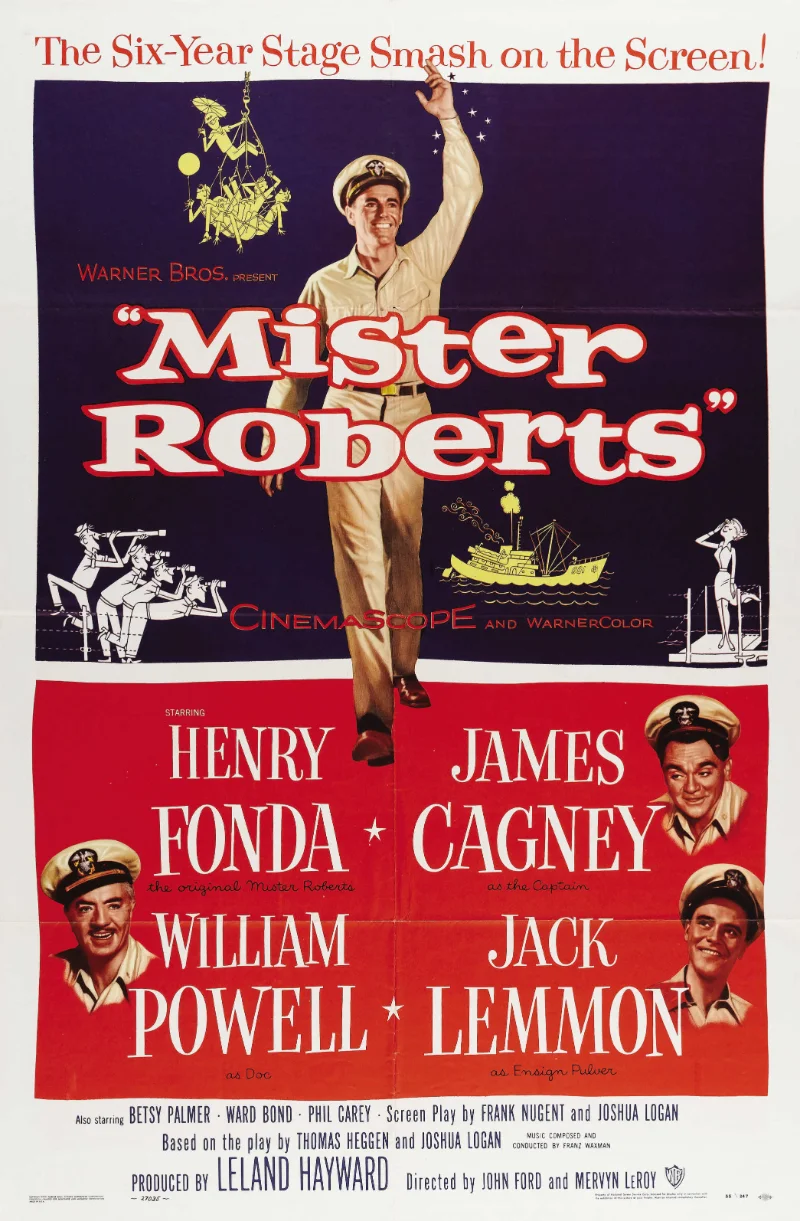
Mister Roberts (1955), directed by John Ford, stands as a poignant reflection on the human condition amid the tumult of World War II, widely recognized as both a military comedy and a character-driven drama. This film marks a significant entry in Ford's illustrious repertoire, showcasing his masterful ability to blend humor with deep emotional undertones. While the backdrop of the Pacific theater during the war provides a familiar setting, particularly within the genre of wartime narratives, Ford infuses this story with a unique theatricality that captures the frustrations and camaraderie of life aboard a cargo ship, providing a refreshing lens on the era’s widespread themes of courage, decency, and integrity.
Central to the film's narrative is the character of Lt. Doug Roberts, played with sincerity by Henry Fonda. His journey reflects the internal and external conflicts faced by those serving their country: a balancing act between duty to the Navy and a longing for a sense of purpose beyond the confines of a mundane assignment. Reviews commonly cite the film's exploration of patriotism as a double-edged sword; while there is an undeniable call to serve, the film suggests that true valor often lies in pursuing one’s personal convictions and moral compass, even (or especially) in the face of bureaucratic indifference. Here, Fonda’s performance emerges as a highlight, marrying vulnerability with resolve, echoing sentiments of rejuvenation in both character and audience.
Critics have noted how Mister Roberts operates not only as an anti-war statement but also as a commentary on the anarchy that can arise amidst military rigidity. The tension between Lt. Roberts and the tyrannical Captain, portrayed by James Cagney, illustrates this effectively, encapsulating the clash between personal ethics and institutional loyalty. Ford’s direction encourages the film to oscillate between moments of frantic hilarity and somber reflection; this blend results in an experience both familiar and unique to audiences. The refreshing use of comic elements interplayed with grave responsibilities serves to humanize the characters, rendering them relatable even against the historical backdrop of war.
Moreover, the film acknowledges the powerful camaraderie forged in shared adversity, providing glimpses into the lived experiences of a crew resiliently thrusting against the waves of conflict. The cargo ship, which serves as both setting and metaphor, becomes a microcosm of broader society, reflecting the complexities of fraternity and conflict in wartime. The performances throughout the ensemble cast bring out this dynamic beautifully, inviting viewers into a deeply personal narrative that transcends the typical war film tropes. Every character, from the ship's petty officers to its enlisted men, contributes to the overarching theme of rejuvenation, each caught in a web of duty and desire, creating layers of sentiment that linger long after the final reel.
Critics' consensus embraces Mister Roberts as a film that skilfully intertwines comedy and pathos against the backdrop of a global conflict, earning its place in cinematic history as an exploration of not merely duty but identity in trying times. Ford’s aptitude for storytelling, sharpened over decades, allows for a nuanced portrayal of individuality amidst collective strife, making this film a timeless reflection of the human spirit navigating a world beset by chaos. As such, Mister Roberts remains a crucial work, harmonizing humor with historical gravity in a narrative that remains deeply resonant.