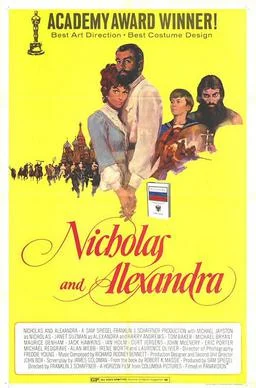
In the landscape of historical epic cinema, Franklin J. Schaffner's Nicholas and Alexandra emerges as a significant yet contentious entry. Released in 1971, this film attempts to encapsulate the tumultuous fall of the Russian Romanov dynasty during the lead-up to the Russian Revolution. Schaffner, known for his grand and sweeping narratives, was regarded as a master of translating complex historical events into visual spectacles, evidenced by his earlier successes like Planet of the Apes and Patton. However, Nicholas and Alexandra finds itself, despite its lavish production values, ensnared in criticism for its pacing and excessive length, which some reviewers claim transforms it from an engaging drama into a bloated historical recounting.
At the core of Nicholas and Alexandra lies a poignant exploration of royalty amidst revolution, depicting the personal and political conflicts experienced by Tsar Nicholas II and his wife, Alexandra. The film portrays their struggles to maintain their reign against an increasingly restless populace yearning for change. While the lavish costumes and big-budget design elements enhance the film's authenticity and grandeur, they ultimately serve as a double-edged sword. Critics note that the opulence often overshadows the narrative, leading to moments that feel both unwieldy and dull. The episodic structure, while ambitious, leaves viewers with a sprawling sense of disorganization rather than a cohesive tale.
Reviewers frequently cite the film’s historical scope as both a strength and a detriment. On one hand, the epic nature of the story attempts to confront the weighty issues of class and power, conveying the magnitude of the royal family's disintegration. However, this same ambition leads critics to label the narrative as pompous, often failing to delve deeply into character development or emotional engagement. The exploration of Nicholas and Alexandra's personal lives, entwined with the backdrop of a crumbling empire, could have been a poignant juxtaposition. Instead, many argue that the film lacks the depth necessary to resonate powerfully with its audience.
Cinematically, Nicholas and Alexandra serves as an interesting artifact of the 1970s film era, showcasing a trend toward grandiosity often seen in historical dramas. Although it aimed to capture a defining moment in Russian history, the film's sprawling narrative has often been perceived as an expensive misstep. Critics agree that the film's failure to balance the lavishness of production with compelling storytelling stands out as a key flaw, rendering the film an unwieldy experience that is as fascinating to dissect as it is disappointing in execution. Thus, while Schaffner's vision of imperial Russia is visually arresting, it confronts the harsh reality of narrative miscalculation.
In conclusion, Nicholas and Alexandra embodies the tension between ambition and execution, reflecting both the majesty of the Romanovs and the chaos of their decline. This film, despite its striking visuals, often feels caught in its own grand designs, ultimately serving as a cautionary tale on the pitfalls of historical epics that prioritize spectacle over substance. While it stands as an important piece for discussions surrounding cinema history, it remains a divisive work that elicits a range of reactions, from admiration for its production values to criticisms of its narrative failures.