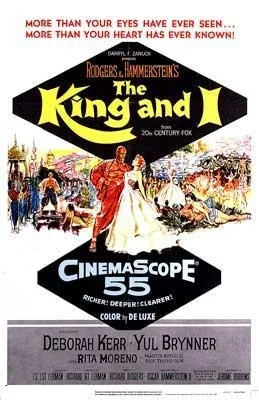
The King and I, directed by Walter Lang and released in 1956, stands as a vivid emblem of mid-20th century cinema, blending elaborate musical elements with broad cultural themes. This film adapts the stage musical by Richard Rodgers and Oscar Hammerstein II, positioning it within a rich tapestry of American musical history. Lang, known for his capacious visual style and ability to command large-scale productions, took on the challenge of presenting a story that dances precariously on the edge of romance and cultural representation while attempting to navigate the complexities of tradition and modernity.
Critical consensus around The King and I often highlights its striking visual allure and memorable musical numbers, yet these qualities coexist with a sense of colonial complacency. The film's lush cinematography and vibrant costuming invite audiences into the opulent world of Siam, yet the romance that blooms between Anna Leonowens and King Mongkut also raises challenging questions about cultural imperialism and the portrayal of Eastern societies through a Western lens. Reviews frequently point to a palpable cultural clash at the heart of the narrative, where education and enlightenment are positioned against a backdrop of tradition and conservative values, encapsulating a spirit of contradiction that defines the film's appeal.
While the romantic undercurrent between Anna and the King unfolds charmingly, critics caution against the romanticization of a colonial perspective. Phrases like "fine-acted" and "magnetic" frequently punctuate assessments of the film, yet an undercurrent of discomfort simmers as audiences confront the sanitized depiction of a society grappling with the thorns of colonial rule. This poses deeper questions about historical accuracy and representation; the film often prioritizes a “frock-happy” aesthetic over a nuanced exploration of its cultural subjects, leading some viewers to note that it at times feels "phoney" or "tidied-up" in ways that may mislead rather than educate.
Moreover, as a product of its time, The King and I reflects the complexities inherent in portraying cross-cultural exchanges. While it's undeniably engaging, critics have pointed out its sprawling nature, characterizing the narrative as "spirited" yet also "distant," suggesting a disconnection that inhibits a full understanding of the cultural stakes involved. As modern audiences revisit the film, they do so with lenses shaped by contemporary discussions around representation and the intricacies of historical narratives, scrutinizing the charming surface for its underlying implications.
Ultimately, The King and I emerges as both a beloved classic and a curious artifact of 1950s cinema. Its lush visuals and catchy scores invite enjoyment, but they also force viewers to reckon with the inherent contradictions of cultural appropriation and colonial nostalgia. Thus, it remains both a romantic escape and a poignant reminder of the complexities entwined in histories of influence, showcasing the duality that characterizes much of Lang’s oeuvre, a blend of spectacle interspersed with troubling truths.