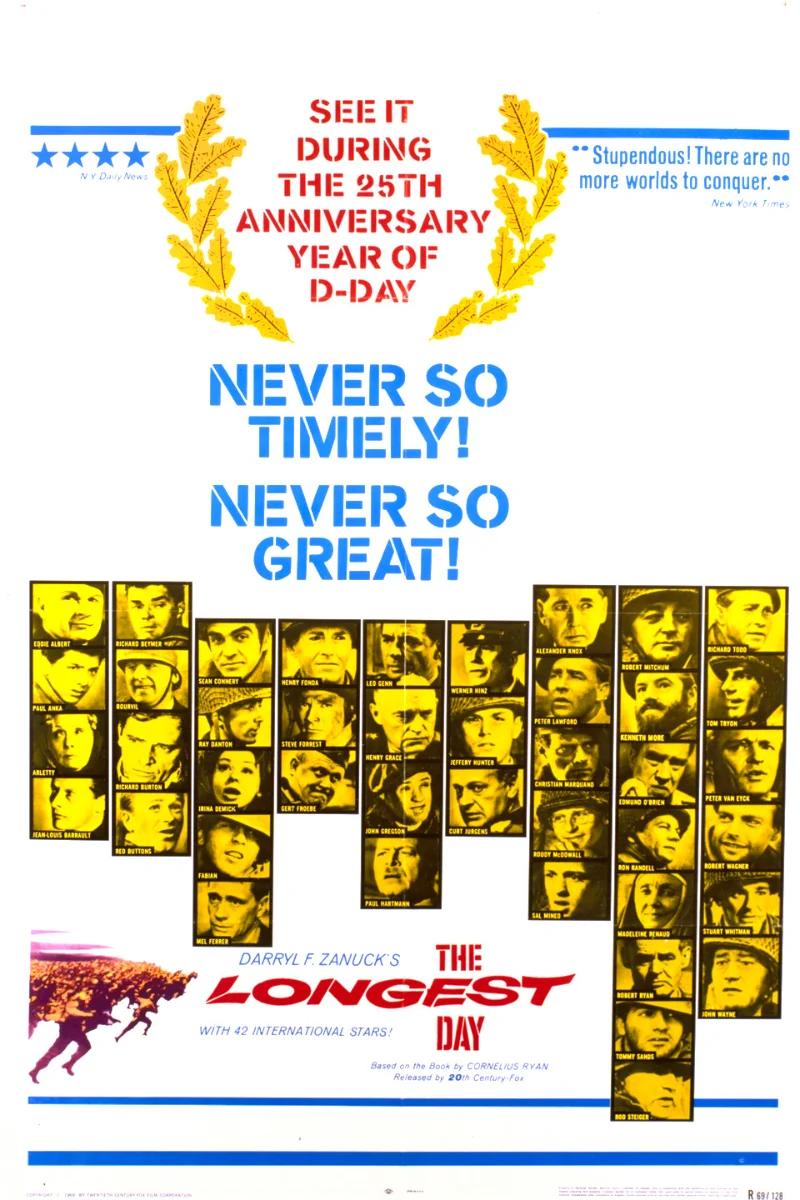
Released in 1962, The Longest Day stands as a monumental achievement in the realm of war cinema. Directed by a cadre of filmmakers including Ken Annakin, Andrew Marton, Gerd Oswald, and Bernhard Wicki, the film boasts an international flair that mirrors the coalition forces involved in the D-Day invasion. Its commitment to historical accuracy and epic storytelling sets it apart in an era where cinematic representations of World War II were beginning to flourish. With an all-star cast featuring renowned actors such as John Wayne, Robert Mitchum, and Sean Connery, The Longest Day serves not only as a recounting of a pivotal event but as a landmark moment in ensemble filmmaking.
Critics have lauded The Longest Day for its ambitious scope and attention to detail, providing an immersive look into the complexities of the D-Day invasion. The film's portrayal of this historical juncture goes beyond mere battle scenes; it encapsulates the emotions, sacrifices, and acts of heroism that defined those pivotal hours. The realistic battle sequences contribute a visceral quality, making the viewer feel the gravity of the events as they unfold, thus securing the film's status as a heartfelt epic that remains memorable even decades later.
As an exploration of international collaboration in warfare, The Longest Day leverages its diverse cast and multiple perspectives to present a multifaceted view of D-Day. The film doesn't simply focus on American soldiers but also includes British, Canadian, and German viewpoints, thereby enriching the narrative and embracing the complexity of wartime experiences. This diversity not only enhances the storytelling but also reflects the collective effort that was essential to the operation, making it an important prototype for future films that seek to portray global conflicts.
In terms of cinema history, The Longest Day occupies a unique position as a product of its time, pushing the boundaries of what a war film could achieve. Its epic dimensions and realistic portrayals foreshadow the visual and narrative strategies that would dominate the genre in later decades. Its influence can be seen in many contemporary war dramas and documentaries, a testament to its pioneering spirit in depicting historical events with authenticity.
The critical consensus around The Longest Day highlights both its technical accomplishments and its emotional resonance. Viewers and film scholars alike have come to appreciate the mammoth scale of its production, alongside the heartfelt storytelling that resonates with audiences worldwide. Ultimately, it stands as a landmark film that captures not just a day of immense importance in history, but a universal narrative of sacrifice and valor that continues to inspire.