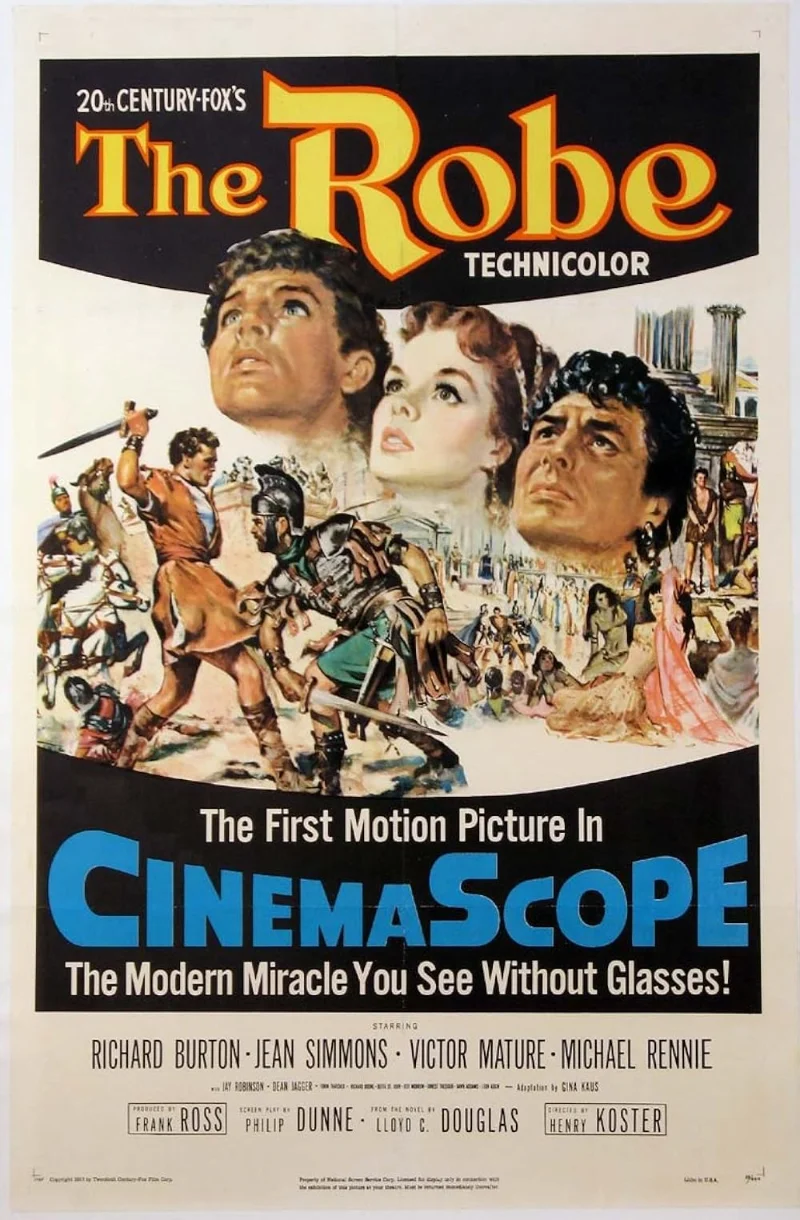
Released in 1953, The Robe marks a significant moment in the evolution of biblical epics within American cinema, showcasing the artistic vision of director Henry Koster. The film stands out as one of the first to utilize the new CinemaScope format, allowing for grander visuals that matched its ambitious narrative ambitions. Koster, known for his ability to blend spectacle with emotional depth, was well-positioned to handle this story of faith, conversion, and redemption set against the backdrop of the Roman Empire. The Robe emerges amidst a surge of religious-themed films of the era, aiming to attract both mass audiences and critical acclaim through its lavish production values and sincere storytelling.
The narrative follows the journey of Marcellus Gallio, a Roman tribune played earnest by Richard Burton, who is tasked with overseeing the crucifixion of Jesus. This event triggers a profound transformation in Marcellus, one that reflects the film's primary themes of religious conversion and redemption. Critics have noted how the film effectively captures the struggle between paganism and the nascent rise of Christianity while exploring the intricate relationship between faith and personal redemption. The lavish sets, visually impressive cinematography, and well-mounted performances contribute to an epic quality that aims to uplift and inspire audiences.
While The Robe is frequently praised for its grand scale and earnest portrayals, it is not without its detractors. Some reviews criticize the film for approaching its themes with a degree of pomposity, viewing the portrayal of faith as overly sentimental or showy. The reverence with which the subject matter is treated can sometimes border on schlock, leading to a perception that the film, despite its solid execution, fails to resonate on a deeper emotional level for every viewer. Nonetheless, the film maintains a devoted following, with many appreciating its uplifting message and historical context.
In the broader landscape of cinema history, The Robe holds a unique position. It not only paved the way for a wave of biblical epics in the 1960s and beyond but also marked the beginning of a renewed interest in religious narratives in mainstream Hollywood. Koster's work, while sometimes marred by a heavy-handed approach, ultimately seeks to deliver a message of hope and the power of faith, a noteworthy ambition for its time. As we reflect on the cultural impact of The Robe, it becomes clear that the film encapsulated both the aspirations and limitations of cinematic interpretations of faith at mid-century.