Career Overview
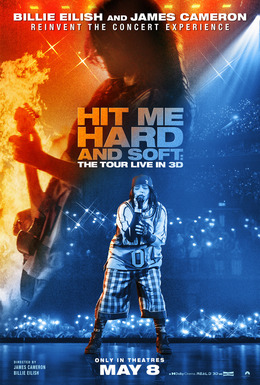
Billie Eilish entered the cinematic landscape as a director with a project that bridged her established identity as a generational pop icon and her emerging ambitions as a visual storyteller. Her transition into filmmaking is anchored by her shared directorial credit on the 3D concert film Billie Eilish Hit Me Hard and Soft: The Tour, a project that situates her alongside veteran blockbuster auteur James Cameron. This unusual pairing marks a distinct chapter in the history of cinema centered around musicians. Rather than passively participating as the subject of a traditional documentary, Eilish actively shaped the translation of her live performance into a theatrical event.
Her development from the subject of R.J. Cutler's observational documentary Billie Eilish: The World's a Little Blurry to the orchestrator of her own sprawling cinematic endeavor illustrates a rapid evolution in creative control. By stepping behind the camera, Eilish claimed authorship over the very mechanics of her stardom. The choice to utilize 3D technology for her directorial debut signals a desire to push the boundaries of the concert film format, moving beyond simple documentation to create an immersive, electrifying atmosphere for her audience.
Within the broader context of contemporary cinema, Eilish occupies a unique position. She is part of a growing movement of global pop stars who use theatrical releases to bypass traditional media narratives, constructing their own definitive archives. Her foray into directing demonstrates a keen awareness of how modern audiences consume spectacle. While her filmography as a director is currently limited to this single monumental collaboration, it establishes her as a creator willing to experiment with massive technological tools to capture the intimate reality of her musical persona.
Thematic Preoccupations
A central preoccupation of Eilish's directorial vision is the inherent tension between youthful vulnerability and the isolating realities of global pop stardom. Across her work on Billie Eilish Hit Me Hard and Soft: The Tour, she constantly navigates the paradox of performing deeply intimate, emotionally raw music for massive stadium crowds. The film investigates how a bedroom intimacy can survive within an arena, posing questions about the nature of authenticity when magnified to a spectacular scale.
Audience engagement functions not just as a byproduct of her concerts, but as a primary thematic subject. Eilish explores the modern concert experience as a site of profound emotional connection, treating the crowd as an essential component of the cinematic narrative. The camera frequently seeks out the faces of her fans, attempting to document the symbiotic relationship between the performer and the observer. This focus transforms the concert film from a mere recital into a study of collective catharsis and parasocial devotion.
However, this pursuit of an engaging narrative is occasionally complicated by the flashy presentation demanded by modern event cinema. Eilish seems obsessed with finding the human element amidst overwhelming technological artifice. Her directorial choices reflect a deep curiosity about whether the subtle, hushed qualities of her music can withstand the demands of a massive multimillion dollar production. This ongoing dialectic between the intimate and the spectacular remains the defining philosophical concern of her nascent filmography.
Stylistic Signatures
The visual language Eilish employs is characterized by a jarring but fascinating collision of mismatched elements. Her primary stylistic signature involves contrasting the bombastic scale of 3D technology with the quiet, insular nature of her musical performances. Working with stereoscopic cameras, she constructs a visual environment that attempts to physically surround the viewer, aiming for an electrifying atmosphere that replicates the physical sensation of attending a live show.
Cinematographically, Eilish relies heavily on extreme closeups to convey the intricate emotions of her music. This technique forces a sense of visual proximity, pulling the audience directly into her personal space. By isolating her face against the sprawling, chaotic backdrop and vibrant color palettes of the stage design, she emphasizes the isolation of pop stardom. The editing rhythms often oscillate between frenetic, high energy cuts during upbeat numbers and prolonged, lingering shots that allow the youthful vulnerability of her lyricism to take center stage.
Despite these ambitious techniques, her approach to visual staging occasionally yields an underwhelming production value, as noted by contemporary critics. The attempt to merge subtle musicality with flashy, immersive visuals sometimes results in a stylistic dissonance. The 3D effects, rather than enhancing the emotional core of the performance, occasionally distract from it. Nevertheless, this very friction between her hushed sonic profile and the aggressive visual format defines her unique, if uneven, stylistic footprint.
Recurring Collaborators
The defining creative partnership in Eilish's directorial career is her highly publicized collaboration with James Cameron. Directing Billie Eilish Hit Me Hard and Soft: The Tour with a filmmaker renowned for his technological maximalism created a unique synthesis of two wildly different artistic sensibilities. Cameron brought his unparalleled expertise in 3D cinematography and massive production logistics, providing Eilish with an enormous canvas upon which to project her intimate musical vision.
This collaboration serves as the foundation for the film's entire aesthetic. Cameron's influence is evident in the film's attempt to achieve an immersive, overwhelming visual scale, while Eilish's contribution grounds the spectacle in emotional reality. The partnership highlights a fascinating negotiation between a veteran director obsessed with building expansive worlds and a young artist focused on internal emotional landscapes. Their combined efforts attempt to forge a new visual vocabulary for the concert documentary genre.
Because her directorial work is currently focused on her own live performances, Eilish herself operates as her primary onscreen collaborator. The relationship between Eilish the director and Eilish the performer is central to the work. She must objectively capture her own subjective experience, directing her onstage persona to serve the broader cinematic narrative. This dual role requires a level of reflexivity that heavily influences the intimate, vulnerable tone of the final product.
Critical Standing
Eilish's critical standing as a filmmaker is defined by a deeply polarized reception. Her directorial debut sparked intense debate among film critics and music journalists alike. Proponents of her work, such as those at RogerEbert.com, have lauded Billie Eilish Hit Me Hard and Soft: The Tour as one of the best concert films of recent vintage, praising Eilish for an execution that successfully engages and moves audiences. These champions highlight the film's electrifying atmosphere and its successful translation of her emotional connection with fans to the silver screen.
Conversely, a significant faction of the critical establishment views the project as a flawed experiment. Publications like The Guardian argued that style trumps substance in the 3D oddity, suggesting that the bombastic visual approach fundamentally misses the subtlety of her music. Critics at Slant Magazine echoed this sentiment, pointing to the mediocrity of the 3D effects and arguing that the film fails to totally succeed in capturing the massive scope of the show. This divide places Eilish at the center of a critical conversation about the aesthetic value of 3D technology in nonfiction cinema.
Within the historical pantheon of the genre, critics frequently contextualize her work by drawing comparisons to seminal texts like Jonathan Demme's Stop Making Sense and contemporary behemoths like Taylor Swift: The Eras Tour. While her film is often judged against the observational intimacy of her previous documentary, Billie Eilish: The World's a Little Blurry, her choice to embrace a flashy collaborative spectacle has complicated her auteur status. Eilish currently stands as a highly ambitious but uneven filmmaker, a fascinating figure whose conceptual reach occasionally exceeds her cinematic grasp.