Career Overview
Cameron Crowe emerged in the late twentieth century as a filmmaker distinctly concerned with the intersection of popular culture and personal authenticity. His transition from music journalism to screenwriting and eventually directing allowed him to cultivate a unique voice in American cinema. He developed a reputation for capturing the zeitgeist of his era, blending sincere emotion with a keen observational eye for contemporary social dynamics.
His early directorial efforts, notably Say Anything and Singles, established his foundational cinematic vocabulary. These films were characterized by a quirky film style and a heady narrative approach that resonated strongly with younger audiences. Reviewers noted that these initial projects showcased a director reaching for a different kind of more, attempting to harmonize raw human feeling with the polished demands of studio filmmaking.
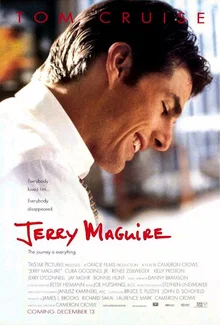
The release of Jerry Maguire marked a definitive turning point in his career trajectory. This project elevated Crowe from an acclaimed chronicler of youth culture to a major Hollywood auteur with a highly successful directorial vision. The picture achieved massive box office success and record breaking impact, merging his signature emotional depth with the robust framework of a mainstream feature, thereby cementing his enduring position in cinema history.
Thematic Preoccupations
Crowe's filmography is anchored by recurrent investigations into personal transformation and the search for authentic connection within a hypercommercialized world. In Jerry Maguire, this central thematic preoccupation manifests as a crisis of conscience regarding sports industry ethics. The protagonist must navigate the grueling tension between moral integrity and corporate greed, illustrating Crowe's fascination with individuals who risk everything to live according to their newfound principles.
Romantic relationships serve as the primary crucible through which Crowe's characters achieve their necessary self actualization. Rather than treating romance as a supplementary subplot, Crowe positions these intimate dynamics at the very core of his thematic architecture. He explores how vulnerability and mutual support lead to a heartwarming conclusion, ultimately arguing that professional success is hollow without genuine personal affection.
A persistent philosophical concern in his work is the delicate balance between conventional societal expectations and individual idealism. The friction between predictable plot twists and surprising emotional moments reflects his deep interest in characters who inhabit conventional structures but continually strive to transcend them. Through unexpected humor and earnest dialogue, Crowe repeatedly asks whether true authenticity can survive in a world driven by profit and cynical calculation.
Stylistic Signatures
Crowe's visual and auditory language relies heavily on a heady narrative approach that prioritizes shrewd character development over ostentatious camera movements. His cinematic environments are typically rooted in a naturalistic, lived in aesthetic. This grounded visual style serves a crucial function, as it tethers the occasionally unbelievable plot points of his scripts to a recognizable reality, making the emotional stakes feel immediate and authentic.
Music operates as an indispensable element of Crowe's stylistic signature, functioning not merely as a background score but as a vital narrative engine. The rhythm of his editing is frequently dictated by the emotional cadence of popular music, a technique that significantly amplifies the emotional depth of his scenes. This synthesis of sound and image contributes heavily to the quirky film style that critics consistently praise.
His dialogue is equally rhythmic, seamlessly blending unexpected humor with earnest, heart on sleeve declarations. This highly specific verbal pacing creates immersive moments where audiences reportedly want to hug themselves with delight. The deliberate juxtaposition of a conventional romantic comedy framework with sharp, idiosyncratic dialogue remains one of the most defining and successful elements of his directorial vision.
Recurring Collaborators
While the current database highlights a standalone focus without recurring cast members across multiple films, Crowe's collaborative ethos remains central to his entire cinematic output. His work frequently relies on charismatic lead actors who possess the gravitational pull necessary to anchor his heady narrative approach. These performers must adeptly navigate his rapid tonal shifts, moving effortlessly between broad comedy and vulnerable drama.
In Jerry Maguire, the seamless alignment of the director's vision with the lead actor's performance resulted in a phenomenally successful and critically praised film. This partnership underscores Crowe's exceptional ability to elicit career defining performances that subvert a major star's established persona. By collaborating closely with his leads, Crowe transforms typical romantic archetypes into complex vehicles for profound personal transformation.
Behind the camera, Crowe's reliance on highly skilled cinematographers and editors ensures that his emphasis on shrewd character development is always visually and rhythmically supported. These vital creative partnerships enable him to balance the strict commercial demands of box office success with his distinctively quirky film style. Ultimately, this collaborative harmony ensures a cohesive and deeply affecting aesthetic across his most celebrated projects.
Critical Standing
Cameron Crowe's critical reputation has frequently oscillated between high praise for his emotional sincerity and occasional skepticism toward his reliance on familiar narrative conventions. Critics have consistently lauded his distinct ability to deliver surprising emotional moments that resonate with wide audiences. Simultaneously, rigorous analytical reviews often note the presence of predictable elements within his storytelling, particularly in his sports and romantic sequences.
The reception history of Jerry Maguire perfectly exemplifies this critical dichotomy. Reviewers celebrated the film's unexpected humor and its record breaking impact at the box office, sometimes drawing unusual but telling cultural comparisons to distinct works like Boyz N the Hood and Star Trek VI: The Undiscovered Country when discussing broad audience resonance and genre execution. Yet, those same critics were quick to point out the highly conventional romantic comedy structure operating beneath the vibrant dialogue.
Over time, Crowe's place within critical discourse has been defined by his status as a populist auteur who successfully injects mainstream cinema with undeniable emotional depth. While early evaluations of works like Say Anything and Singles suggested a filmmaker whose quirky style was still coalescing, his subsequent triumphs firmly established his reputation. He remains widely recognized as a director uniquely capable of crafting critically praised films that bridge the gap between commercial appeal and intimate, character driven art.