Career Overview
Vidhu Vinod Chopra occupies a distinctive position in the landscape of Indian cinema. He is a filmmaker whose career arc demonstrates a continuous evolution from mainstream commercial fare toward deeply grounded biographical dramas. Educated at the Film and Television Institute of India, Chopra built a foundation of technical rigor that would inform his decades-long career as both a director and a producer.
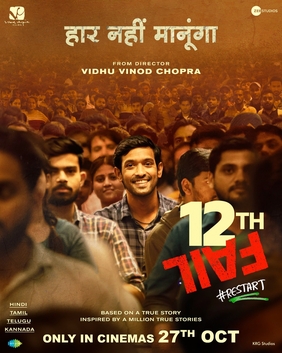
His later work, exemplified by the acclaimed 12th Fail, represents a distillation of his cinematic priorities. In this phase of his career, Chopra strips away the artifice of traditional Bollywood spectacle to focus on stark realities and systemic inequalities. By centering his narratives on real individuals navigating extreme poverty, he bridges the gap between populist entertainment and vital social commentary.
Within cinema history, Chopra stands as a classicist who utilizes traditional narrative structures to address contemporary social ailments. His trajectory showcases a filmmaker who has matured into a didactic but deeply empathetic storyteller. He consistently leverages his industry clout to elevate stories of marginalized individuals striving for recognition within inflexible bureaucratic systems.
Thematic Preoccupations
A pervasive preoccupation with systemic corruption and the arduous quest for justice anchors the filmography of Vidhu Vinod Chopra. He consistently interrogates the mechanisms of power in India, exploring how educational challenges and economic disparity create nearly insurmountable barriers for the lower classes. The personal perseverance journey becomes his primary vehicle for philosophical inquiry.
The concept of meritocracy serves as a central battleground in his narratives. Chopra asks whether social mobility is genuinely attainable or merely an illusion sustained by an indifferent state. In films like 12th Fail, the protagonist must survive a grueling gauntlet of examinations and societal prejudices. Success in this context is framed not as a stroke of luck but as a supreme moral victory over a compromised system.
Despite the bleak socioeconomic landscapes his characters inhabit, Chopra remains fiercely committed to inspirational themes and motivational storylines. He employs a didactic narrative approach to ensure his social mobility messages are unambiguous. The ultimate triumph of his heroes serves as a heartwarming testament to human resilience, reinforcing his enduring belief in the power of unyielding effort.
Stylistic Signatures
Chopra employs a cinematic storytelling technique that carefully balances stark realism with highly calibrated emotional resonance. His visual language often emphasizes the physical toll of poverty, contrasting cramped, impoverished living conditions with the imposing architecture of academic and government institutions. This spatial dichotomy visually reinforces the social divides his protagonists must conquer.
Critics have observed a surprising structural sophistication in his work, occasionally drawing comparisons to the investigative pacing of the David Fincher film Zodiac or the intricate plotting associated with Agatha Christie conventions. This manifests in how Chopra treats the pursuit of education and career advancement. The academic rigorousness and bureaucratic hurdles are framed with the tension of a procedural thriller, turning rote memorization and exam preparation into compelling cinematic stakes.
In the editing room, Chopra prioritizes narrative momentum and emotional clarity over avant-garde experimentation. His use of sound design and score leans heavily into sentimental elements, utilizing swelling orchestral movements to punctuate heartwarming moments. This stylistic synthesis results in a highly accessible cinematic form, one that leverages familiar emotional cues to guide the audience through complex social critiques.
Recurring Collaborators
Unlike auteurs who rely on a dedicated repertory company of actors, Chopra has historically adapted his casting strategies to serve the specific demands of his biographical and social narratives. Across the featured database entries, there are no recurring cast members identified. This absence underscores his commitment to finding the precise performer suited for each unique milieu, rather than bending a story to fit a favored star.
This pragmatic approach to casting is essential for the authenticity required in character studies like 12th Fail. By avoiding a fixed onscreen ensemble, Chopra ensures that the audience remains focused on the thematic weight of the narrative and the specific struggles of the real people depicted. The lack of familiar faces in these lead roles heightens the documentary-like realism of his social mobility messages.
Behind the camera, Chopra relies on highly skilled technicians who can execute his vision of grounded but emotionally expansive cinema. While the faces on screen may change, his reliance on specific cinematographers and composers provides a cohesive stylistic signature. These vital behind-the-scenes collaborations enable Chopra to maintain a consistent atmosphere of struggle and eventual triumph across his varied projects.
Critical Standing
The critical reputation of Vidhu Vinod Chopra reflects his status as a masterful orchestrator of mainstream emotional cinema and rigorous social critique. Reviewers consistently praise his ability to transform dry subjects like educational challenges into gripping narratives of perseverance. His work is frequently analyzed for its cinematic storytelling techniques, which successfully merge the tension of a thriller with the empathy of a biographical drama.
However, his overtly didactic narrative style has generated a nuanced critical discourse. Reviewers analyzing 12th Fail in publications like The Guardian note that his films often foster the idea that success is possible through effort alone. Some critics argue that this approach frames social advancement as almost an arithmetic problem, where sheer determination inevitably equals triumph, occasionally oversimplifying the very systemic issues he seeks to expose.
Despite these critiques regarding his sentimental elements, Chopra maintains a highly respected place within critical circles. His genuine commitment to highlighting overcoming corruption and promoting integrity earns him widespread acclaim. Ultimately, his standing is that of a seasoned veteran who utilizes the vast reach of popular cinema to deliver poignant, necessary messages about meritocracy and justice.