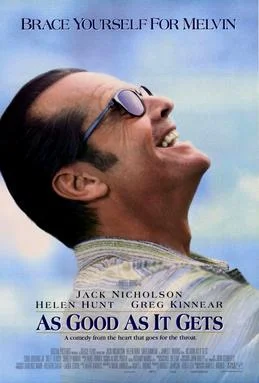
James L. Brooks’s As Good as it Gets stands as a significant entry in 1990s cinema, blending elements of romantic comedy with a sardonic yet heartfelt look at human relationships. Renowned for his ability to craft complex characters, Brooks delivers a narrative that navigates the tumultuous waters of obsessive-compulsive disorder (OCD) while exploring the messy nature of love and connection. The film's place within Brooks's body of work is notable; it exemplifies his signature style of intertwining humor with emotional depth, making it a distinct and memorable piece in a decade rich with diverse comedic films.
Critics have generally lauded As Good as it Gets for its outstanding performances, particularly that of Jack Nicholson, who portrays Melvin Udall, a misanthropic author whose idiosyncratic behavior anchors the story. The film's exploration of OCD is both disturbing and enlightening, allowing audiences to empathize with Melvin's struggle while also finding the irony in his outrageous antics. This duality creates a layer of complexity that elevates the film beyond a mere romantic comedy, crafting moments that are as touching as they are funny. Helen Hunt, whose performance as Carol Connelly earned her an Academy Award, plays the waitress who becomes an unlikely catalyst for Melvin’s transformation, showcasing how love can emerge from the most unexpected circumstances.
The critical consensus emphasizes the film's ability to balance humor with poignant character development. Brooks masterfully creates a narrative that is at once entertaining and reflective, providing insights into the human condition. The screenplay is peppered with smart-funny dialogue that keeps the audience engaged, while also integrating political incorrectness that reflects the film's audacious spirit. The film’s production quality is high, with a strong visual and auditory identity that complements its thematic depth, ensuring that it resonates on multiple levels with viewers.
Audience reception to As Good as it Gets has been overwhelmingly positive, with many drawn to its heartwarming moments amid a narrative steeped in irony and absurdity. It is not just a romantic comedy; it is a study of relationships that examines the imperfections of its characters while celebrating the resilience of the human spirit. This duality, along with an engaging plot and memorable performances, has cemented its status as an entertaining classic in the genre.
In retrospect, As Good as it Gets offers a rich tableau of emotions, deftly interweaving the absurdities of life with the unyielding desire for connection. Its blend of humor, complexity, and character-driven storytelling reveals the heart of what makes romantic comedies resonate long after the credits roll. As a benchmark in both Brooks's filmography and the cinematic landscape of its time, it remains a profound exploration of love that continues to engage and entertain audiences today.