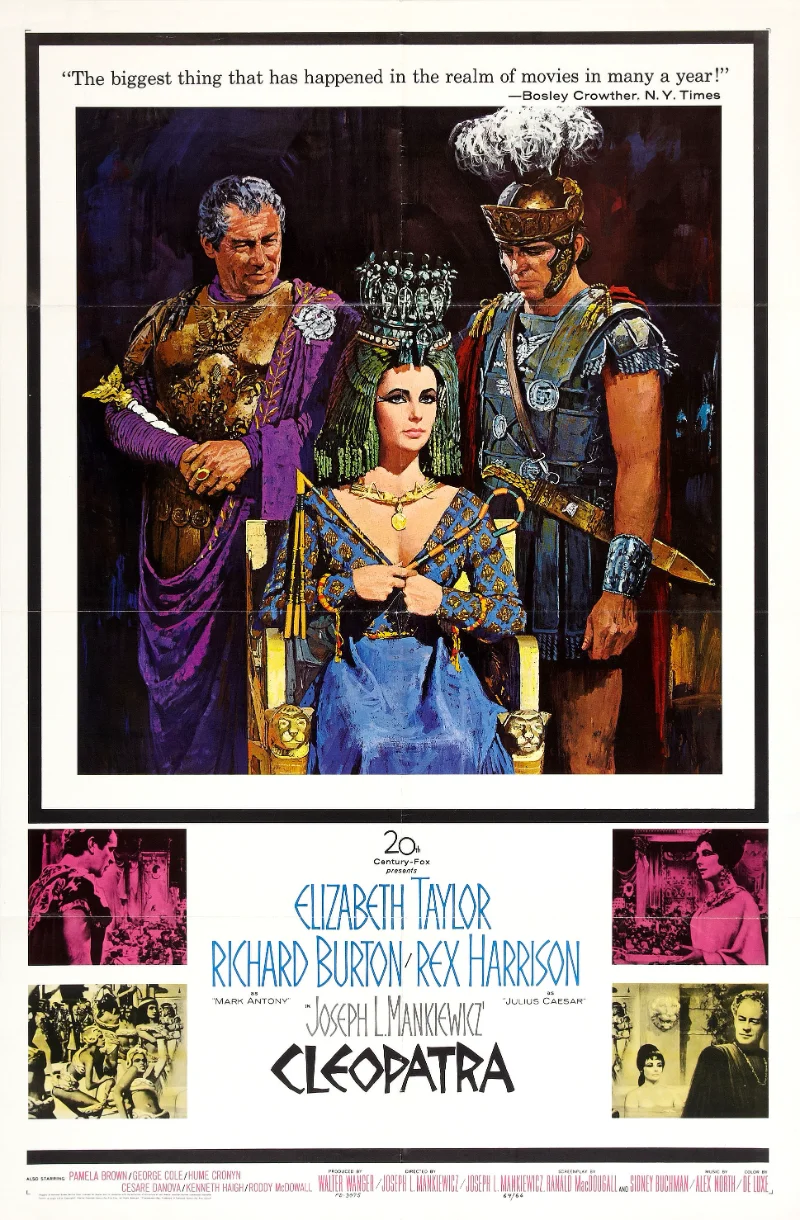
Joseph L. Mankiewicz's Cleopatra (1963) stands as a monumental example of the historical epic genre, yet its legacy is laced with contradictions, from its grandiose production to its disastrous financial outcomes. Following a nearly decade-long development process, the film aimed to capture the rich tapestry of ancient politics and romance surrounding one of history's most captivating figures. Emerging from a troubled production marked by reshoots, script inconsistencies, and budget overruns, Cleopatra showcases Mankiewicz’s ambition to create a visually spectacular portrayal of its titular queen, while simultaneously reflecting the broader tumult of the Hollywood studio system during the early 1960s.
Critics have often noted the lavishness of Cleopatra, comparing it to a dazzling, albeit overblown, canvas that frequently stumbles under the weight of its own ambition. The film presents a romantic drama intertwined with political intrigue, exploring Cleopatra’s manipulations within the political machinations of Rome. While the film offers sweeping moments of grandeur, evident in its elaborate costumes and sprawling sets, it has also been criticized for a rambling narrative that struggles to maintain focus amid its spectacular visuals. Many felt that the script did not adequately support Mankiewicz’s vision, leading to inconsistent storytelling that detracts from what could have been a cohesive historical drama.
Financially, Cleopatra was a cautionary tale in Hollywood history; despite its massive investment and expectations for box office success, it emerged as one of the biggest flops of its time. The film's exorbitant costs were a significant factor in the eventual financial destabilization of 20th Century Fox, prompting a shift in how studios approached the production of epic films. The impact of Cleopatra on the industry was profound, serving as both a warning against unchecked artistic ambitions and a blueprint for the grand epics that followed, albeit with more caution regarding budgets and production scales.
Restored for modern audiences, Cleopatra maintains its status as a cultural artifact laden with historical significance, both in its attempts to depict ancient narratives and in its own tumultuous production journey. While contemporary reviews might regard it with a mix of fascination and critique, it undeniably stands as a testament to the era's cinematic aspirations and the complexities of its production industry. The film remains a focal point in discussions not merely of cinematic history but also of celebrity culture, as the scandal surrounding Elizabeth Taylor's casting and her off-screen affair with co-star Richard Burton drew massive media attention, cementing their status as one of Hollywood's most infamous couples.
In conclusion, Cleopatra is emblematic of both cinematic brilliance and excessive folly, a film that oscillates between being a mesmerizing visual feast and a cautionary tale of excess. Its historical missteps and production challenges mirror the turbulent nature of the era, leaving the modern viewer with a blend of admiration and exasperation. The film is a significant chapter in the annals of cinema, capturing the relentless pursuit of grandeur while exposing the inherent vulnerabilities of an industry at the crossroads of ambition and reality.