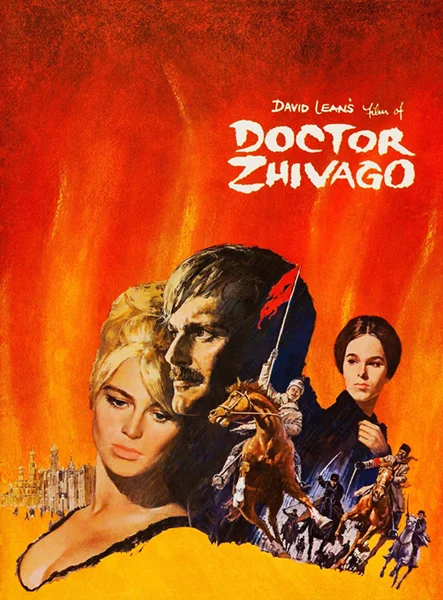
David Lean's Doctor Zhivago stands as a monumental achievement in the realm of historical cinema, emblematic of the director’s capacity to weave vast, ambitious narratives that explore the heart of human experience amid the turbulence of societal upheaval. Released in 1965, the film not only established itself as a visual spectacle, with its sweeping landscapes and opulent cinematography, but also profoundly resonated within the larger context of the Cold War era, reflecting to audiences a deep-seated yearning for human connection amidst the chaos of revolution. Lean, already acclaimed for his earlier works like Lawrence of Arabia, continued to parade his mastery over epic storytelling, but with Doctor Zhivago, he perhaps faced some of the most pronounced challenges of adaptation, attempting to distill Boris Pasternak's sprawling novel into a coherent cinematic experience.
Critics have frequently highlighted the film’s central theme of love in the face of relentless revolution, showcasing how personal relationships can bloom even while political landscapes are in turmoil. The characters of Yuri Zhivago and Lara Antipova embody this struggle, caught in a world that demands personal sacrifices in the name of ideology. The juxtaposition of the individual against the vast machinery of the state is especially poignant, emphasizing how love can often act as an oasis amid the desert of historical events. However, some reviews have suggested that this focus on romance can detract from the more incisive political themes within the narrative, with the emotional weight sometimes veering into the territory of sentimentality, rendering parts of the film ‘soppy’ rather than insightful.
The film's lavish production values have been both praised and critiqued. The grand scale of Lean’s vision is undeniable, yet some have expressed that the focus on visual grandeur can occasionally overshadow the narrative depth. Reviewers have used descriptors like ‘masterful’ and ‘mammoth’ to praise the film’s ambition, while simultaneously noting that this magnitude can lead to a ‘reduced’ engagement with the complexities of urgent political matters. As Doctor Zhivago unfolds, its melodrama captivates while also risking an emotional disconnect, a duality that keeps it both magnetic and, at times, inexplicably frustrating. The balance Lean achieves, or struggles to achieve, between the intimate and the epic is a pivotal conversation point for those dissecting the film’s legacy.
Another layer to consider is the adaptation challenge that Lean faced in transitioning Pasternak's prose to the screen. The narrative required careful trimming and a selective focus, which has led some critics to find certain plot lines less compelling than others. While the film retains an essential romantic ethos, the necessity for brevity has come at the cost of depth for some subplots and characters. This tension between fidelity to the source material and the demand for cinematic pacing reveals a duality inherent in such adaptations, making Doctor Zhivago a fascinating case study in the intersection of literature and film.
Ultimately, Doctor Zhivago remains a cinematic spectacle that encapsulates the dualities of love, sacrifice, and identity amid historical turmoil. It straddles the line between emotional melodrama and a reflective historical drama, securing its place in film history as both a masterful portrayal of complex human relationships and a grand, sweeping depiction of political chaos. Critics may differ in their assessments, yet the film undeniably evokes a profound contemplation on the roles of love and state, resonating deeply with audiences long past its initial release.