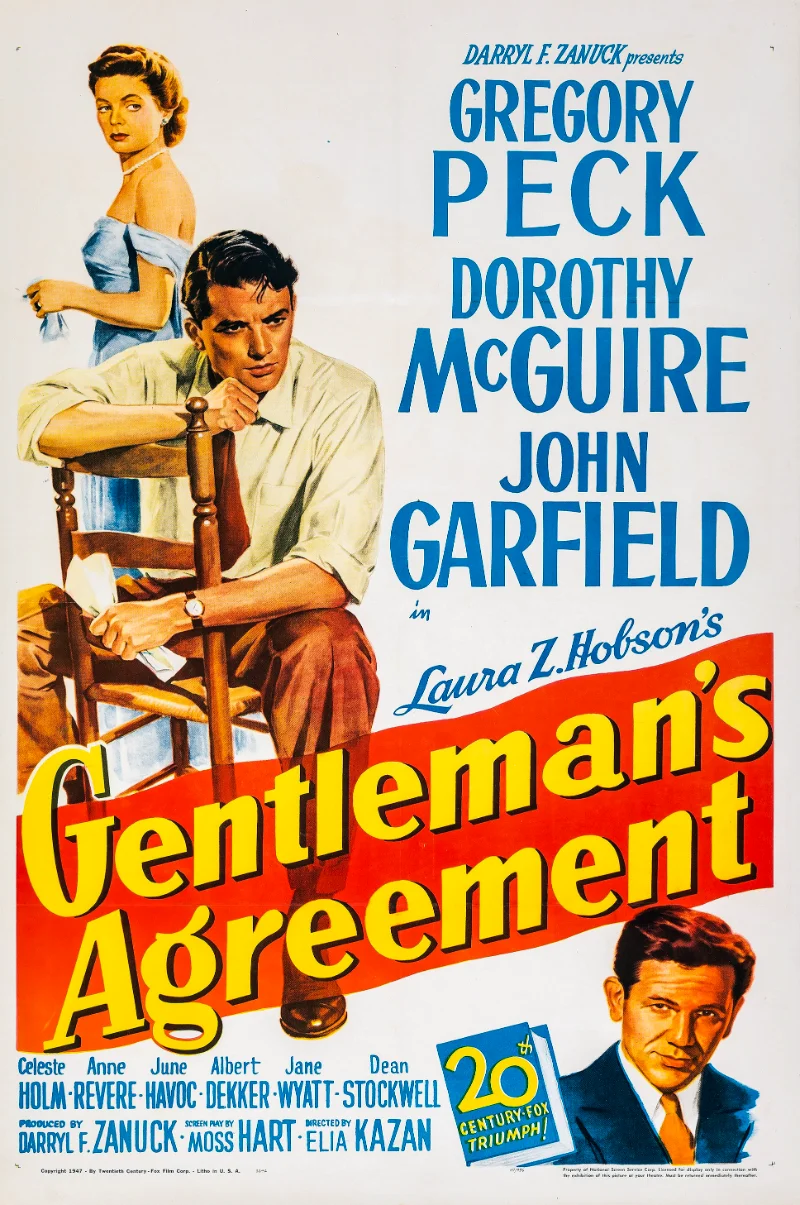
Elia Kazan's Gentleman's Agreement stands as a significant entry in the canon of post-war American cinema, reflecting the preoccupations of its time while also pushing the boundaries of social commentary in film. Released in 1947, the film was a groundbreaking examination of anti-Semitism in America, exploring the insidious nature of prejudice through the perspective of a journalist who adopts a Jewish identity for research. Kazan, known for his method-acting approach that emphasized emotional authenticity, delivers a sophisticated narrative that is as much a social experiment as it is a melodrama. In a period when Hollywood was wrestling with themes of identity and social justice in the aftermath of World War II, Gentleman's Agreement invites viewers to confront uncomfortable truths about their own beliefs and behaviors.
At the heart of the film lies a critique of apolitical liberalism, encapsulating the struggles of those who consider themselves progressive yet fail to actively oppose discrimination. Kazan combines elements of high melodrama with sharp social commentary, creating an emotionally charged atmosphere that resonates with audiences. The main character's journey delves deeply into the complexities of identity, as he navigates a world rife with prejudice while confronting friends and family who are unwilling to acknowledge their own biases. Critics have noted that this self-examination is reflective of a broader societal reluctance to engage with uncomfortable truths, positioning the film as a commentary not just on anti-Semitism but on the human condition itself.
The critical consensus around Gentleman's Agreement acknowledges its earnestness and sophistication, yet some reviews highlight its limitations. While the film is commendable for its ambitious approach to a pressing social issue, it also runs the risk of falling into the trap of social-issue martyrdom, with its protagonist embodying a somewhat simplistic heroism that may not captivate all audiences. This melodramatic element, combined with Kazan's method-acting techniques, elicits strong emotional responses, yet it prompts a discussion surrounding the efficacy of melodrama in truly addressing systemic problems. In placing personal relationships at the forefront, the film somewhat obscures the broader social structures that contribute to discrimination, instead reducing complex issues to personal revelations.
In this respect, Gentleman's Agreement invites a nuanced analysis of its portrayal of forgotten extreme-right figures and the societal contexts that enable such ideologies to thrive. The film’s portrayal of anti-Semitic attitudes serves to amplify its critique of societal complacency, challenging audiences to reflect on their complicity in prevailing prejudices. Critics describe the film’s tone as furious yet classy, underscoring Kazan’s ability to handle sensitive subjects with both sophistication and anger. This duality is essential to understanding the film's impact on viewers, who are left to grapple with the moral dissonance presented on screen.
Ultimately, Gentleman's Agreement remains relevant not only as a product of its time but as a lens through which contemporary audiences can explore ongoing issues of identity, discrimination, and the responsibilities that come with liberalism. Kazan’s direction invites audiences to ponder whether mere acknowledgment of prejudice is sufficient for social change or if active dismantling of ignorance is required. In the context of film history, this work stands out as an ambitious attempt to not only reflect the societal spirit of its era but also to provoke meaningful discussions that resonate to this day.