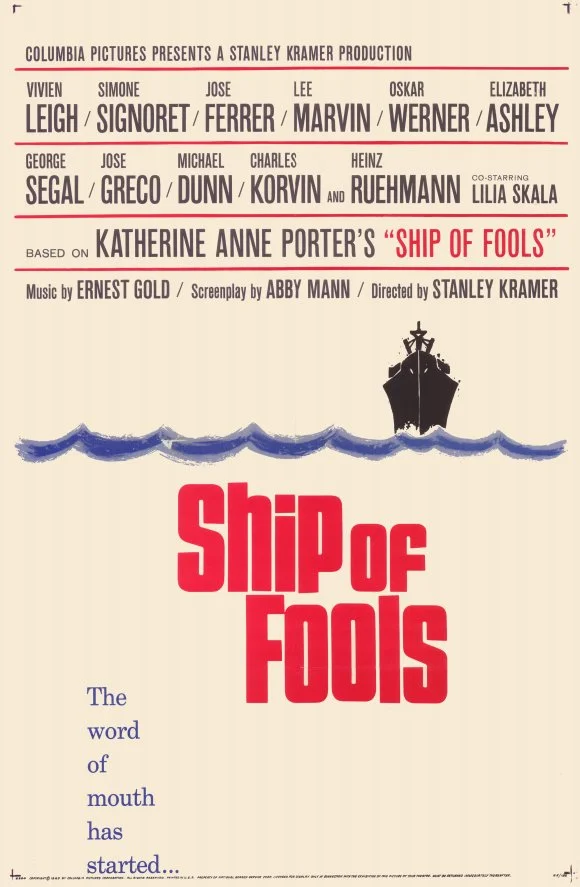
Stanley Kramer's Ship of Fools stands as a notable yet divisive chapter in both the film's history and the oeuvre of its director. Released in 1965, this ambitious drama attempts to encapsulate the social tensions and human follies that permeated pre-World War II Europe. Set aboard a traveling ship, the film employs a star-studded ensemble cast, including the likes of Vivien Leigh, Lee Marvin, and Maximilian Schell, to navigate through a tapestry of characters as diverse and complicated as the era itself. Kramer's work here is marked by an epic sensibility, yet it often veers into the melodramatic, creating a cinematic experience that fluctuates between profound moments of reflection and overtly verbose dialogues.
Critics have commonly remarked upon the film's unevenness, encapsulating a common sentiment that while Kramer's ambitions are laudable, they are also laden with excessive elements that sometimes detract from the narrative. The storytelling aims for an exploration of themes like moral ambiguity, social injustice, and existential despair, framed within the impending shadow of global conflict. However, the lavish production and melodramatic tone can result in clumsy execution, where the weight of the narrative feels overwhelmed by the film's length and the verbosity of its script. This dichotomy underscores a critical tension in Ship of Fools, striving to be both an epic commentary on human nature and a reflective character study.
At its core, Ship of Fools wrestles with the folly of humanity, where each character embodies different facets of societal dysfunction. Kramer's portrayal of the characters reflects the real-life anxieties and prejudices of 1930s Europe, mirroring a world teetering on the precipice of catastrophe. Reviews reveal a shared understanding that these characters are not merely archetypes; they serve as a mirror to the audience, revealing our own potential for folly amidst chaos. The film becomes a microcosm of society, challenging viewers to confront their own biases and behaviors in the face of societal unrest. With each character contributing to the tapestry, Kramer's ensemble reminds us of the collective responsibility that prevails in moments of crisis.
Despite its shortcomings, the film remains a significant artifact of its time, reflecting both the artistic ambitions of 1960s cinema and the complex cultural landscape following the war period. Critics have noted that while Ship of Fools may falter in its execution, it nonetheless sparks important conversations about morality, coexistence, and the fragility of human dignity. Kramer's work may not be universally lauded, but its portrayal of a world on the brink injects a necessary urgency into its themes, prompting reflection on the perennial nature of human folly. In an era marked by discord and divide, Ship of Fools remains a vital piece for audiences willing to grapple with difficult questions, serving as a reminder of the lessons history offers us in our present.