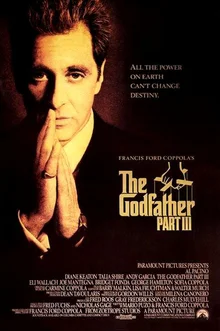
Released in 1990, The Godfather Part III stands as a poignant, if contentious, conclusion to Francis Ford Coppola's iconic trilogy, which has been seminal in the landscape of American cinema. While the first two installments are frequently hailed as masterpieces that captured the essence of the American Dream corrupted by organized crime, the third film revisits the themes of family legacy and redemption within a more modern context. It attempts to reconcile the weight of legacy with the burdens of power, embedding within its narrative a sense of tragic inevitability that echoes throughout the saga.
Critics have been divided in their reception of The Godfather Part III, with many acknowledging its compelling narrative while also expressing disappointment in comparison to its predecessors. Despite this, the film is undeniably ambitious, weaving together the threads of betrayal and loss that characterize the Corleone family saga. The story's focus on Michael Corleone, now a weary patriarch seeking redemption and grappling with his family's dark history, serves as a reflective mirror to the earlier films. This exploration of personal versus familial responsibility provides a rich tapestry that resonates, even if some viewers find the film less accessible.
The themes of family legacy permeate every aspect of The Godfather Part III. As Michael strives to distance himself from the violent legacy of his past, the challenges he faces illustrate the intricate balance between ambition and morality. However, tragedy befalls him at every turn, showcasing the inescapable truth that one's lineage cannot easily be severed from the choices made before. The film intricately builds on this tragic dimension, revealing how the pursuit of power often leads to profound betrayals, not only of others but also of oneself. Critics have responded positively to the film’s emotional depth, even as they critique its pacing and occasional tonal inconsistencies.
In terms of performances, Al Pacino delivers a riveting portrayal of Michael Corleone, embodying the character's transformation into a man increasingly haunted by his past. Sophia Coppola, in her film debut, also lines up alongside actors such as Andy Garcia and Diane Keaton, each contributing to the film's complex emotional landscape. Through compelling performances, The Godfather Part III engages viewers deeply, invoking both sympathy and disdain for its characters, reinforcing the idea that in the world of the Corleones, personal ambition often intersects tragically with family ties.
Ultimately, The Godfather Part III remains a significant yet polarizing entry in a beloved series that has shaped the contours of modern filmmaking. Its legacy is multifaceted; while it may not have the immaculate reverence of its forebears, it is nevertheless a vital examination of a man’s struggle for redemption amidst a backdrop of impending doom. As audiences grapple with themes of loyalty, power, and the quest for identity, this film endures as a robust consideration of how one’s past invariably shapes one’s future.