Career Overview
Brian De Palma occupies a uniquely polarizing space in American cinema. Emerging alongside the New Hollywood movement of the 1970s, he quickly established himself as a provocateur. His work often operates at the intersection of pulp genre conventions and rigorous formalist aesthetics. By the early 1980s, De Palma shifted his focus toward grand narratives of American greed, cementing his reputation as a chronicler of cultural moral decay.
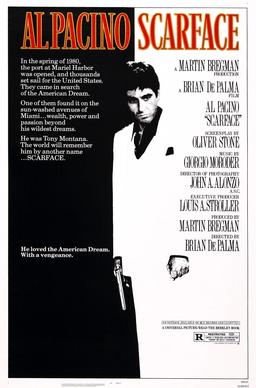
The release of Scarface in 1983 marked a watershed moment in De Palma's trajectory. Moving away from the Hitchcockian thrillers that characterized his early period, he embraced a broader, more operatic scale. This transition allowed him to explore the limits of mainstream cinematic acceptability. His willingness to push boundaries positioned him both as a maverick and a target for conservative cultural critics.
Throughout his career, De Palma has maintained a complex relationship with the Hollywood studio system. He operates as an auteur within a heavily commercial framework, utilizing massive budgets to stage subversive critiques of American capitalism. His legacy is inextricably tied to his audacity, proving that commercial cinema can accommodate deeply cynical, formally audacious visions of the modern world.
Thematic Preoccupations
At the core of De Palma's filmography lies a profound fascination with the corruption of the American Dream. He frequently examines the immigrant experience through the lens of criminality, suggesting that ruthless ambition is the inevitable byproduct of a hypercapitalist society. His protagonists, such as the Cuban refugee Tony Montana in Scarface, are driven by an insatiable hunger for wealth and status, ultimately discovering that the realization of their desires leads directly to their destruction.
The rise and fall of the gangster serves as De Palma's preferred mythological framework for exploring these themes. Unlike earlier moralistic crime films, his narratives embrace the seductive nature of power. The ascent to the top of the criminal underworld is depicted with intoxicating energy, highlighting the material rewards of absolute ruthlessness. However, this ascent is inevitably followed by a descent into paranoia, addiction, and spiritual emptiness.
Violence and excess function not merely as spectacle in De Palma's work but as thematic cornerstones. He views American culture as fundamentally violent, a society where success is measured by the sheer accumulation of capital and the domination of others. By pushing these elements to their absolute limit, De Palma forces audiences to confront the grotesque reality underlying the pursuit of extreme wealth and limitless power.
Stylistic Signatures
De Palma is celebrated for a visual language that can only be described as brutal and unsubtle. He completely rejects the restrained realism favored by many of his contemporaries, opting instead for an operatic intensity that overwhelms the senses. His camera is restless and voyeuristic, utilizing sweeping tracking shots and intricate crane movements to map out the spatial geography of his characters' extravagant worlds.
This intense storytelling approach is heavily reliant on a strategy of maximalism. Every element of the visual composition is pushed to the limit, from the ostentatious production design to the saturated color palettes that mirror the escalating madness of his protagonists. In films like Scarface, the visual excess perfectly encapsulates the thematic focus on greed, creating a sensory overload that places the viewer directly inside the chaotic mindset of a rising drug lord.
The director's editorial rhythms further amplify this sense of cinematic bombast. De Palma frequently employs prolonged, tension building sequences that explode into sudden, visceral violence. When paired with synthesized, driving musical scores, these sequences achieve a fever pitch momentum. He willingly sacrifices subtlety for sheer impact, constructing set pieces that are designed to shock, provoke, and linger in the cultural consciousness.
Recurring Collaborators
While De Palma's cinematic universe is defined primarily by his singular directorial vision, his projects are often elevated by highly specific, potent collaborations. Rather than relying on a fixed stable of recurring actors across multiple films, he tends to forge intense partnerships tailored to the specific needs of a project. The most prominent example from his 1980s output is his collaboration with screenwriter Oliver Stone.
Stone's contribution to Scarface provided the perfect literary foundation for De Palma's visual extravagance. The screenplay injected a politically charged, aggressive edge into the narrative, grounding the operatic crime saga in the gritty reality of the Mariel boatlift and the Miami drug trade. This synthesis of Stone's confrontational writing and De Palma's grandiose direction resulted in a uniquely abrasive form of storytelling.
Onscreen, De Palma's work requires performers capable of matching his heightened stylistic register. Al Pacino's performance as Tony Montana remains the quintessential realization of a De Palma protagonist. Delivering a performance of volcanic intensity, Pacino dominates the frame, acting as the anchor for the film's relentless momentum. His deeply physical, Mephistophelean interpretation of the character demonstrates exactly the kind of fearless acting that De Palma's uncompromising cinema demands.
Critical Standing
The critical reception of Brian De Palma's work has historically been deeply divided, characterized by fierce debates over his artistic merit. Upon initial release, his most confrontational films were frequently dismissed by mainstream critics as exercises in gratuitous violence and vulgarity. Reviewers often labeled his approach as brutally unsubtle, struggling to reconcile his undeniable technical mastery with his seemingly lurid subject matter.
Over time, however, a significant critical reevaluation has occurred. Modern film scholars now frequently position his crime epics alongside foundational texts like The Godfather and Goodfellas. While Francis Ford Coppola and Martin Scorsese are often praised for their tragic or sociological approaches to the mobster mythos, De Palma is celebrated for his unapologetic embrace of pulp elements. His willingness to push it to the limit is now understood not as a flaw, but as a deliberate and successful artistic strategy.
Today, publications ranging from Slant Magazine to Variety recognize his 1980s output as essential viewing within the American cinematic canon. Retrospective reviews frequently highlight the lasting cultural impact of his intensely stylized filmmaking and the potent performances he captures. Ultimately, De Palma has secured a reputation as a master provocateur whose brutally honest depictions of American excess have aged into vital, prophetic works of art.