Career Overview
George Clooney arrived at his directorial career with a foundation deeply entrenched in the mechanics of television and journalism. His father, Nick Clooney, served as a news anchor for three decades, a familial background that immersed the young Clooney in the broadcast environment. He first stepped onto a studio floor at the age of five, an experience that cultivated a lifelong fascination with the ethical and operational realities of the newsroom. This early exposure eventually informed his transition from a prominent leading man to a filmmaker of serious, historically minded cinema.
His initial foray behind the camera was Confessions of a Dangerous Mind, a film characterized by its gregarious and over-styled assault on the landscape of trash television. While that debut demonstrated his visual ambition, it was his subsequent historical drama that solidified his status as a director of notable substance. Clooney traded the chaotic excess of his first project for a more disciplined, rigorous approach, turning his attention to mid-century American politics and broadcast history.
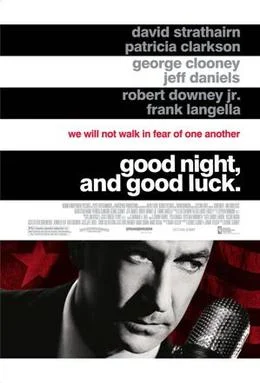
With Good Night, and Good Luck., Clooney established himself as a director capable of navigating complex historical terrain with both restraint and contemporary resonance. By focusing on veteran CBS journalist Edward R. Murrow and his team, Clooney bridged his personal reverence for the journalistic profession with a potent critique of political overreach. This evolution marked a definitive shift in his career arc, positioning him as an important cinematic voice dedicated to exploring the intersection of media, truth, and civic duty.
Thematic Preoccupations
At the core of George Clooney's directorial vision is a profound preoccupation with media responsibility and the ethical boundaries of journalism. His work frequently interrogates the role of the press in holding power accountable, framing broadcast history not merely as a subject of nostalgia but as a vital battlefield for democratic ideals. The pursuit of truth becomes a central philosophical concern, wherein characters are forced to navigate the treacherous waters of political courage and institutional pressure.
The concept of freedom of speech operates as a foundational pillar in his thematic architecture. By examining the anti-communist crusades of the 1950s, Clooney reflects on the vulnerability of civil liberties in times of national paranoia. The dichotomy between figures like Edward R. Murrow and Senator Joseph McCarthy serves to highlight a broader fixation on contrast, pitting journalistic integrity against demagogic exploitation. The narrative functions as a study of individuals attempting to remove a cancer from the body politic with surgical precision.
Crucially, Clooney utilizes historical reflection as a vehicle for urgent political commentary. Critics have noted that his work contains implied jabs at the twenty-first century global news media, drawing parallels between past crises and modern events like the coverage of Hurricane Katrina. This alignment of historical narrative with timely themes allows his films to resonate beyond their period settings. Clooney continuously returns to the question of whether contemporary media possesses the fortitude to challenge authority, demanding authentic storytelling and courageous representation in the face of political intimidation.
Stylistic Signatures
The visual and atmospheric language of George Clooney's work is defined by a rigorous, graceful, but workmanlike approach to cinematic storytelling. Moving away from the over-styled aesthetics of his debut in Confessions of a Dangerous Mind, his matured style leans heavily into downbeat narratives and restrained compositions. He meticulously crafts a claustrophobic atmosphere, trapping his characters within the confined, smoke-filled rooms of mid-century television studios to mirror the suffocating political pressures of the outside world.
This atmospheric claustrophobia is sustained through a masterful modulation of implied tension. Rather than relying on overt melodrama, Clooney builds suspense through the procedural minutiae of broadcast journalism. The editing rhythms mimic the ticking clock of a live television broadcast, generating an underlying urgency that drives the narrative forward. This focus on process reflects his authentic approach to the subject matter, allowing the physical environment of the newsroom to become a character in its own right.
Performance and mise-en-scene are closely integrated to amplify the thematic weight of his films. Clooney favors a minimalist emotional palette, encouraging stealthy, coded performances from his actors. Feelings and convictions are often buried beneath professional stoicism, revealed only through surgical precision in delivery and subtle shifts in expression. The resulting stylistic signature is one of elegant austerity, where every technical decision serves the overarching pursuit of unvarnished historical truth.
Recurring Collaborators
While George Clooney's directorial filmography features a shifting roster of talent, his approach to creative partnership is characterized by a reliance on highly disciplined actors capable of navigating dense, historically layered material. His focus on ensemble dynamics requires performers who can inhabit the procedural reality of a newsroom without descending into theatricality. This methodology is perhaps best exemplified by his work with David Strathairn, whose portrayal of Edward R. Murrow established a template for the archetypal Clooney protagonist.
Strathairn operates as a stealth actor within Clooney's directorial framework, delivering a performance where intense personal feelings are communicated almost entirely in code. This precise calibration aligns perfectly with the director's demand for authentic storytelling. By anchoring the narrative in such a restrained, internalized performance, Clooney allows the surrounding ensemble to react and operate with matching professional gravity. The dynamic between director and leading man elevates the film from a mere biographical sketch to a tense psychological study.
Beyond individual actors, Clooney's collaborative ethos extends to the broader recreation of historical environments. He works closely with production designers and cinematographers to achieve a meticulous, workmanlike realism that honors the legacy of figures like CBS producer Fred Friendly. Although specific cast members may not recur across every film in his database, his consistent cultivation of a tightly knit, hyper-competent ensemble remains a defining hallmark of his creative process.
Critical Standing
George Clooney's critical reputation as a filmmaker was fundamentally transformed and elevated by his precise execution of historical dramas. Early in his directorial career, projects like Confessions of a Dangerous Mind were viewed as energetic but somewhat undisciplined assaults on trash television. However, his shift toward serious political commentary marked a maturation that critics readily embraced. He is now widely regarded as a filmmaker of significant intellectual ambition, capable of merging accessible classical Hollywood storytelling with rigorous civic critique.
His cinematic standing is heavily bolstered by the overt comparisons critics make to seminal works of the medium. Reviewers frequently invoke Citizen Kane when discussing his thematic depth and sophisticated understanding of media power. By tackling complex subjects with surgical precision, Clooney has earned respect for creating work that functions as a deliberate counterblast to boisterous neocon-revisionist attempts to rehabilitate controversial historical figures. This willingness to engage directly with contentious political legacies has solidified his reputation as a courageous voice in modern cinema.
Today, Clooney occupies a distinct space in the critical discourse as a guardian of traditional journalistic ethics translated to film. His narratives are celebrated for their downbeat realism and refusal to offer easy, triumphant resolutions. Instead, critics praise his implied tension and claustrophobic atmospheres, noting that his films serve as essential mirrors for the failures and responsibilities of the modern global news media. His standing remains that of an essential, critically engaged filmmaker who successfully bridges the gap between historical reflection and urgent contemporary resonance.