Career Overview
Kathryn Bigelow holds a singular position in cinema history as a director who dismantles and reassembles the conventions of masculine action filmmaking. Initially emerging from an arts background, her early career choices positioned her as a formalist interested in subverting genre expectations. In the context of our database, her trajectory is perfectly encapsulated by her early nineties work, which established her ability to balance commercial imperatives with rigorous visual experimentation. Her rise through the ranks of Hollywood directors is notable for her uncompromising commitment to kinetic cinema. While the industry frequently compartmentalizes filmmakers by gender, Bigelow actively pursued narratives entrenched in hyper-masculinity, examining the psychological underpinnings of adrenaline and violence. This approach allowed her to infiltrate the mainstream while maintaining a distinct, critical authorial voice. Her work sits comfortably alongside genre-defining classics like Bullitt and Dirty Harry, yet it operates with a postmodern awareness that elevates it beyond mere replication. By bridging the gap between high art formalism and what some critics have labeled trashy entertainment, Bigelow secured her status as a pioneering force. Her films remain enduring cult gems, marking a critical evolution in how action cinema can function as both spectacle and sociological inquiry.
Thematic Preoccupations
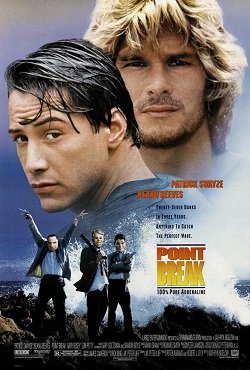
A central preoccupation in Bigelow's filmography is the intoxicating nature of extreme subcultures and the dangerous allure of adrenaline. The thematic anchor of the undercover investigation serves as a perfect vehicle for this exploration. As seen in Point Break, the protagonist is inevitably drawn into the very world they are tasked with dismantling, creating a narrative tension between duty and seduction. The surfing culture portrayed in her work is not merely atmospheric background but a philosophical framework, equating physical risk with spiritual transcendence. The philosophy of action is another recurring obsession. Bigelow interrogates the mechanics of violence and thrill-seeking, often imbuing her testosterone-fueled mayhem with profound philosophical undertones. Her characters operate in a liminal space where bank robbery and extreme sports blur into a singular expression of existential rebellion. This genre-hopping narrative approach allows her to dissect the male ego, revealing both its destructive capacity and its tragic, vulnerable core. Furthermore, her narratives frequently explore the concept of the doppelganger and homosocial bonding. The dynamic between the law enforcer and the outlaw often transcends a simple game of cat and mouse, evolving into a complex mirror relationship. This intriguing plot structure challenges the audience to question conventional morality, as the freaky elements of the criminal underworld prove far more compelling than the rigid structures of institutional authority. Ultimately, Bigelow asks whether true freedom can only be achieved through transgression.
Stylistic Signatures
Bigelow's visual language is defined by an aggressive kineticism paired with precise formal control. Her action sequences are renowned for their immersive quality, often utilizing subjective camera angles and sweeping, continuous movements to place the viewer directly within the chaos. This beautiful cinematography is never merely decorative. It serves an essential narrative function, translating the visceral thrill of surfing or the frantic energy of a chase into a palpable cinematic experience. Despite critical descriptions of her work being almost all style and all technique, this stylistic excess is entirely deliberate. She employs a hyper-kinetic editing rhythm that mimics the adrenaline surges of her characters. The integration of sound and music further amplifies this effect, creating a sensory overload that perfectly matches the over-the-top violence and testosterone-fueled mayhem depicted on screen. Her camera moves with a fluidity that mirrors the ocean waves her characters revere, establishing a seamless connection between environment and action. Her mise-en-scene frequently contrasts the sterile environments of institutional authority with the vibrant, chaotic spaces of the outlaw subcultures. This dichotomy is central to her stylish action aesthetic. By leaning into what some consider preposterous or dumb fun, Bigelow weaponizes genre tropes to create a dense, highly effective storytelling mechanism. The result is a purely cinematic spectacle that demands physiological engagement from the audience while simultaneously offering a critique of the very violence it depicts.
Recurring Collaborators
While our current database identifies no specific recurring cast members across multiple films, Bigelow's collaborative process is characterized by her ability to extract uniquely intense performances from her leading men. She frequently works with actors who possess a potent blend of traditional movie star charisma and underlying vulnerability. This casting strategy is essential for realizing her complex homosocial dynamics, where the chemistry between antagonists drives the emotional core of the narrative. Behind the camera, Bigelow builds partnerships with cinematographers and editors capable of executing her highly technical and physically demanding vision. The seamless execution of her kinetic action sequences requires an exceptional level of coordination and a shared commitment to pushing the boundaries of practical filmmaking. These crew members must navigate dangerous environments, from ocean swells to high-speed pursuits, ensuring that the visual poetry of the frame is never compromised by the logistical challenges of the shoot. Her collaborations also extend to sound designers and composers who help construct the immersive auditory landscapes of her films. Because her work relies so heavily on sensory experience, the audio must reflect the extreme states of her characters. Whether capturing the roar of a wave or the chaotic echo of gunfire, these partnerships are vital in elevating the material from a standard thriller into a sensory exploration of action and adrenaline.
Critical Standing
The critical reception of Kathryn Bigelow's early action films is a fascinating study in evolving cinematic appreciation. Initially, works like Point Break polarized reviewers. Some critics dismissed the material as an exercise in dumb fun or a superficial guilty pleasure, noting that it was as bad as its premise sounds. They argued the film was almost entirely reliant on technique at the expense of narrative logic, viewing it primarily as a preposterous splash of trashy entertainment. However, beneath this veneer of commercial excess, astute critics recognized a superb direction at play. Reviewers acknowledged that Bigelow was an incredibly interesting director for such seemingly lowbrow material, pointing out that the end result was surprisingly effective. Comparisons to enduring classics like Die Hard, Top Gun, and Blue Steel highlighted her ability to navigate the complex landscape of the Long Eighties Decade of Action Movies. Her films were seen as possessing a freaky, genre-hopping style that defied easy categorization. Over time, Bigelow's standing within critical discourse has undergone a significant reappraisal. What was once labeled a guilty pleasure has firmly established its cult classic status and enduring appeal. Contemporary art critics and cinephiles now celebrate her early work for its dense philosophical undertones and its subversive take on masculine tropes. Bigelow is universally recognized as a master technician and a visionary auteur who fundamentally reshaped the aesthetic possibilities of the modern action thriller.