Career Overview
Mathieu Kassovitz emerged as a defining voice in European cinema by probing the deep psychological and societal wounds of alienation among young outsiders. Breaking through at just twenty nine years old, he quickly established himself as a filmmaker uniquely attuned to the volatile undercurrents of the modern urban landscape. His early directorial efforts signaled a seismic shift in how marginalized communities were depicted on screen, forcing audiences to reckon with the harsh realities of a divided society heading blindly for a crash landing.
The chronological development of his career is anchored by his willingness to confront systemic failure directly. Unlike the romanticized visions of Paris often exported to international audiences, Kassovitz presents a world that is geographically and socially isolated from traditional cinematic fantasies. By centering his lens on the neglected banlieues, he crafted an urgent, unvarnished portrait of youth disillusionment that resonated globally and cemented his position as a crucial figure in modern world cinema.
Decades after his initial breakthrough, his legacy only continues to expand in critical circles. His definitive work remains a visceral fable of societal collapse, recently earning prominent rereleases that demonstrate a startling new relevance in contemporary discourse. As critics have noted, his examinations of cultural identity and systemic friction serve as an unmissable response to an unending emergency, solidifying his historical standing as a cinematic provocateur whose insights remain tragically timeless.
Thematic Preoccupations
Kassovitz explores the combustible intersections of youth disillusionment, social unrest, and urban violence. He interrogates the systemic pressures placed upon marginalized groups living in forgotten neighborhoods, treating the physical decay of the city as a direct manifestation of social inequality. The exploration of multiculturalism and cultural identity is not merely a backdrop for his narratives but rather the central philosophical inquiry of his entire cinematic project.
A persistent thread in his storytelling is the fatalistic concept of a society in free fall. As noted by critics, his narratives are fundamentally less about the landing and far more about the fall itself. This perspective frames his depiction of racial tension and police brutality, creating an environment where characters are caught in a restless, aimless cycle of survival. They navigate a hostile world where systemic violence inevitably breeds further devastation, trapping the youth in a perpetual state of alienation.
Despite the overwhelming bleakness of these social divisions, friendship and youth culture serve as the fragile connective tissue holding his protagonists together. Kassovitz contrasts macro sociopolitical decay with the micro loyalties among young men, capturing the genuine humor, boredom, and solidarity of their daily lives. This juxtaposition renders his political commentary both urgent and deeply human, drawing frequent thematic comparisons to Do the Right Thing regarding his exploration of racial friction and the shared moral imperative to do the right thing in the face of structural oppression.
Stylistic Signatures
The visual language employed by Kassovitz is best characterized as viscerally kinetic and unflinchingly raw. He utilizes a dynamic camera to capture the authentic texture of urban decay, actively stripping away any romanticized notions of city life. His aesthetic choices favor stark contrasts and gritty realism, presenting environments that feel suffocating and entirely detached from affluent civic centers.
Pacing and temporal manipulation are critical tools in his stylistic arsenal. By confining narratives to tight, pressure cooker timeframes, such as a single day and night, he generates an unyielding emotional tension throughout the work. This compressed chronological structure mimics the psychological state of his protagonists, creating an atmosphere that is deeply compelling and constantly teetering on the brink of explosion.
His approach to mise-en-scene emphasizes spatial alienation and the overwhelming scale of institutional neglect. Characters are frequently framed against brutalist architecture and sprawling concrete wastelands, underscoring their marginalization within the broader society. The resulting cinematic environment is provocative and impactful, utilizing sound design and rhythmic editing to deliver a sensory experience that feels authentically powerful and immediately confrontational.
Recurring Collaborators
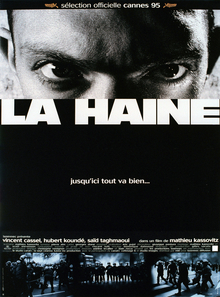
While the available critical database highlights a highly focused snapshot of Kassovitz's filmography, making the identification of a massive recurring ensemble difficult, his approach to performance remains fundamentally rooted in deep, collaborative authenticity. In his seminal work La haine, the central trio of Vinz, Hubert, and Said act as essential avatars for his sociopolitical inquiries, requiring actors who can fully inhabit the complex reality of the banlieues.
The synergy between the director and his performers requires an intense level of vulnerability, stamina, and raw emotional power. Kassovitz demands performances that can sustain a high wire act of emotional tension throughout the entirety of the narrative. By utilizing actors who can genuinely channel the frustrations and humor of marginalized youth, he ensures that complex themes of cultural identity and alienation are conveyed with profound authenticity rather than theatrical artifice.
Furthermore, the collaborative energy in Kassovitz's filmmaking extends to his reliance on the ensemble dynamic as the emotional core of his cinematic universe. The friendships portrayed on screen necessitate a chemistry that feels entirely organic and unforced. This tight collaborative spirit among the cast members anchors his visceral explorations of a divided society, providing the crucial human element required to navigate his politically charged landscapes.
Critical Standing
Mathieu Kassovitz occupies a revered and unique space in contemporary film criticism, celebrated for delivering unapologetic, impactful sociopolitical cinema. Reviewers consistently praise his ability to capture the chaotic zeitgeist of marginalized communities with nuance and ferocity. La haine is widely regarded by institutions and art critics as a definitive classic of banlieue rage, firmly establishing his reputation as a filmmaker unafraid to confront the uncomfortable realities of modern metropolitan life.
The critical comparisons frequently drawn between his work and other landmark films concerning systemic inequality, most notably Do the Right Thing, underscore his elevated international standing. Critics consistently highlight his narratives as urgent and provocative, commending the raw, visceral nature of his storytelling. His willingness to tackle explosive themes of police brutality and social unrest directly has earned him enduring respect from cinephiles and scholars alike.
Perhaps the most defining aspect of his critical legacy is the persistent, haunting timeliness of his work. Decades after their initial release, his films are routinely lauded as unmissable responses to unending emergencies, gaining new relevance in eras defined by modern civil rights movements. The frequent critical observation that his cinema has lost absolutely none of its punch confirms Kassovitz's permanent position as a visionary director whose authentic explorations of social division remain profoundly compelling today.