Career Overview
Steven Soderbergh occupies a unique space in contemporary American cinema, acting as a bridge between independent sensibilities and studio-backed filmmaking. The year 2000 remains a defining apex in his career arc, marked by the simultaneous release of two major works that cemented his reputation as a versatile auteur. By delivering both Erin Brockovich and Traffic in a single calendar year, he demonstrated an extraordinary capacity to navigate diverse genres while maintaining a distinct authorial voice.
His background reveals a relentless drive to deconstruct and rebuild narrative conventions. Initially heralded as a pioneer of the independent film movement, his transition into larger-budget Hollywood productions did not dilute his intellectual rigor. Instead, he utilized the machinery of the studio system to mount expansive critiques of American institutions. This transition proved that an American filmmaker could achieve massive commercial success without sacrificing formal experimentation or political engagement.
Consequently, Soderbergh is often categorized as a workmanlike visionary, a seemingly contradictory label that accurately captures his prolific output and technical proficiency. He approaches filmmaking as a rigorous craft, stripping away the self-indulgence often associated with auteurism in favor of an objective, highly observant perspective. This unique positioning allows him to dissect complex social issues with both clinical precision and profound humanism, securing his place as one of the most essential filmmakers of his generation.
Thematic Preoccupations
A recurring preoccupation in the filmography of Steven Soderbergh is the inherent friction between individuals and monolithic institutions. His narratives frequently dissect systemic failures, interrogating how vast bureaucracies, corporations, and government policies crush marginalized voices. In Erin Brockovich, this takes the form of corporate corruption and environmental activism, framing a classic David and Goliath struggle where an unemployed single mother confronts a negligent utility company. The film highlights high-minded legal advocacy, presenting a scathing anti-corporate critique masked as a character study.
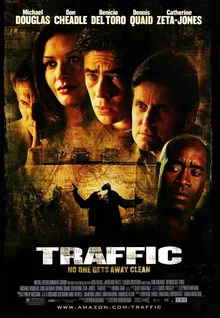
This interest in macro-level societal decay expands significantly in Traffic, where Soderbergh turns his lens toward the devastating consequences of the American war on drugs. Here, the thematic focus broadens to encompass a systemic overview of the narcotics trade, illustrating how flawed drug policies infiltrate every stratum of society. He approaches these massive political failures with deep intellectual curiosity, maintaining a downbeat and ambivalent perspective rather than offering simplistic moral solutions. The Hollywood approach to drug narratives is subverted, replaced by an honest and compassionate portrayal of widespread institutional rot.
Furthermore, Soderbergh is obsessed with the cascading effects of actions within interconnected systems. Whether exploring the localized health crises of a contaminated water supply or the international sprawl of cartels and law enforcement, he maps the intricate webs of consequence. His characters are often trapped within these webs, forced to navigate environments where the pursuit of justice or survival demands compromising their own ethical boundaries. This creates a deeply cynical yet profoundly observant cinematic universe where positive impact is possible but always hard-won.
Stylistic Signatures
Soderbergh is renowned for his highly distinct visual language, often operating as his own cinematographer to maintain complete control over the image. His visual approach is frequently characterized as a run and gun style, favoring agility and immediacy over classical, static compositions. This method injects a documentary-like realism into his fiction, allowing the camera to act as an inquisitive observer. In works like Traffic, this results in a bold and innovative visual texture that utilizes distinct color palettes to delineate separate geographical and narrative threads, ensuring the complex structure remains visually coherent.
Structurally, his tendency toward complex narrative styles is a defining signature. Soderbergh excels at managing interlocking pieces, weaving multiple storylines together to create a comprehensive tapestry of a given subject. He favors panoramic storytelling that forces the audience to draw connections between disparate characters and locations. This architectural approach to editing and pacing creates a dynamic and immersive rhythm, requiring active intellectual engagement from the viewer as they assemble the broader systemic puzzle.
Despite the structural complexity, Soderbergh maintains a surprisingly workmanlike direction that avoids excessive stylistic flourish in favor of narrative clarity. He often employs a clinical, almost detached observational tone, which prevents his socially conscious films from devolving into melodrama. Yet, within this cool exterior, he consistently elicits dynamic and immersive performances from his ensembles. This careful balance between objective distance and intimate character work results in a cinematic style that is both intellectually stimulating and emotionally resonant.
Recurring Collaborators
While a direct overlap of cast members does not occur between Erin Brockovich and Traffic, Steven Soderbergh is famous for assembling brilliant ensemble casts that anchor his complex narratives. He heavily relies on top-tier acting talent to provide the emotional core necessary to support his vast, systemic critiques. By casting highly recognizable stars in challenging, unglamorous roles, he leverages audience familiarity to invite viewers into otherwise alienating or dense political subject matter.
The relationship between the director and his screenwriters is also paramount to his creative success. Collaborations with writers who share his interest in intricate, multi-layered storytelling allow him to construct his sprawling narrative architectures. The interlocking script for Traffic, for instance, provides the necessary blueprint for Soderbergh to execute his damning thesis on failed government policies. These creative partnerships ensure that his films maintain a rigorous intellectual foundation before a single frame is shot.
Ultimately, the performances within his films are what ground his high-minded storytelling. Actors under his direction often achieve superlative, Oscar-worthy efforts, such as the widely celebrated turns by Julia Roberts in Erin Brockovich and Benicio Del Toro in Traffic. Soderbergh strips away the artifice of traditional Hollywood acting, encouraging performances that are reliable, competent, and deeply human. This collaborative environment allows actors to vanish into their roles, delivering honest portrayals that elevate the director's unique vision.
Critical Standing
The critical standing of Steven Soderbergh reached an unprecedented peak at the turn of the millennium, cementing his reputation as a master of contemporary cinema. His dual releases in the year 2000 resulted in a rare critical consensus, recognizing him as a filmmaker capable of producing both Oscar-worthy commercial hits and rigorous sociopolitical critiques. Winning Best Director for Traffic validated his bold and innovative storytelling, establishing him as a favorite among critics who praised his ability to merge intellectual curiosity with mainstream accessibility.
Within critical discourse, his films are frequently subject to comparative analysis alongside other major works of systemic critique. Erin Brockovich is often discussed in tandem with Michael Mann's The Insider as a pinnacle of the modern legal drama, while Traffic is heavily compared to its British television predecessor Traffik. Critics consistently note that Soderbergh accomplishes what few other American directors attempt, providing a systemic overview of massive issues like the narcotics trade without resorting to didacticism. His films are celebrated for their honest portrayals and downbeat perspectives, avoiding the overcorrecting plots common in Hollywood issue films.
Today, Soderbergh occupies a highly respected position as a restless innovator and a pragmatic auteur. Reviewers continue to praise his workmanlike efficiency and his unique capacity to dissect the failures of American institutions. His films remain a vital touchstone for film students and critics analyzing the intersection of narrative economy, visual experimentation, and political engagement. As the landscape of cinema continues to evolve, his body of work stands as a testament to the power of intelligent, socially conscious filmmaking executed with unparalleled technical mastery.